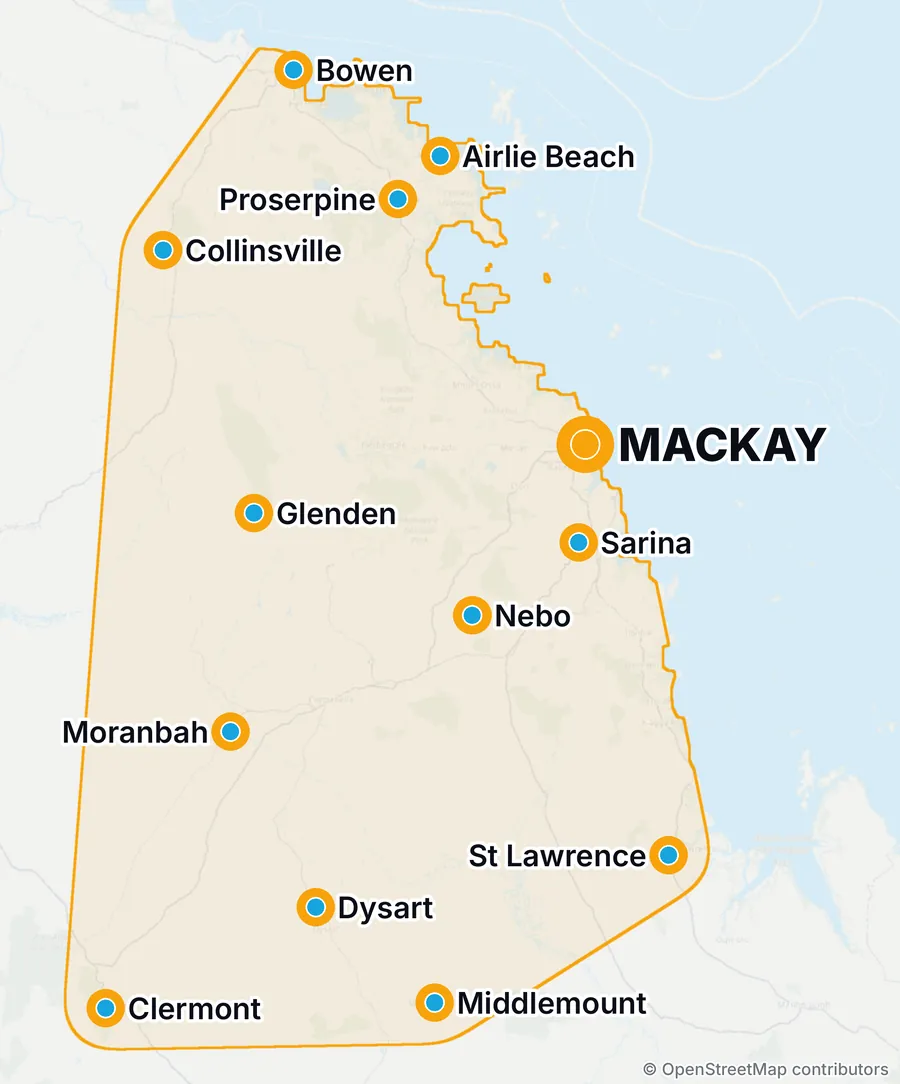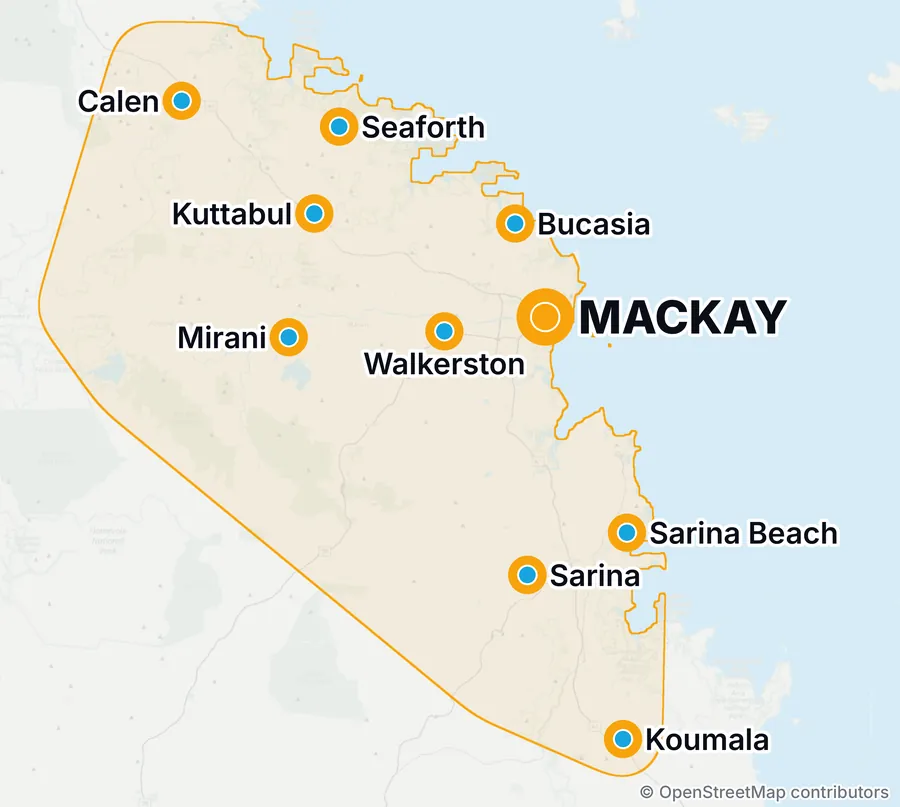

If you have just taken delivery of a Tesla Model 3, BYD Atto 3, Kia EV5 or any other electric vehicle in Mackay, you have probably realised the portable charger that came in the boot is not going to cut it long term. Plugging into a normal 10 amp power point gets you maybe 10 km of range per hour. A proper home charger gets you 40 to 130 km of range per hour, charges overnight while you sleep, and integrates with your solar.
Here is what Mackay homeowners actually need to know before they buy a charger and book an electrician.
The two real options for home charging
Level 1: trickle charger (the cable that came with the car). Plugs into a normal 10 amp outlet. 1.8 to 2.4 kW. Adds roughly 10 to 12 km of range per hour. Fine for plug-in hybrids. Slow for full EVs. Should be on a dedicated circuit, not shared with anything else.
Level 2 single phase 7 kW charger. Hard-wired Level 2 unit on a dedicated 32 amp circuit. Adds approximately 40 km of range per hour. Charges a 60 kWh battery overnight (around 8 to 9 hours). Suits 90% of Mackay homeowners.
Level 2 three-phase 11 kW or 22 kW charger. Requires three-phase power at the house. Adds approximately 60 km/hr (11 kW) or 130 km/hr (22 kW). Useful for households with two EVs, multi-car trips, or vehicles with three-phase onboard chargers (most premium European models, some Tesla Performance variants).
The honest truth about three phase
Most Australian homes are single phase. Most Mackay homes are single phase. A single-phase 7 kW charger is plenty for any EV owner driving normal Mackay commute distances (Bucasia to CBD, Sarina to Paget).
The three-phase upgrade is genuine work:
- If your house already has three phase: roughly $1,800 to $2,600 for a quality three-phase charger installed
- If your house is single phase and you want to upgrade: $2,000 to $5,000 for the supply upgrade depending on what Ergon requires, plus the charger and install
Before paying for a three-phase charger, verify your vehicle’s onboard charger. A Tesla Model 3 Standard Range, BYD Atto 3, MG4 and Hyundai Ioniq 5 Standard Range have single-phase onboard chargers. A three-phase wall charger on these cars delivers 7 kW (one phase), not 22 kW. You spent money for nothing.
If you have a Porsche Taycan, BMW iX, Mercedes EQS or an Ioniq 5 with the 11 kW onboard charger, three phase is worth it.
What a Mackay home EV charger install actually costs in 2026
Real ranges for Mackay residential installs:
| Scenario | Total installed cost |
|---|---|
| Single-phase 7 kW, switchboard in good condition, charger near board | $1,200 to $1,800 |
| Single-phase 7 kW, long cable run (over 10 m) | $1,500 to $2,200 |
| Single-phase 7 kW, switchboard upgrade required | $2,700 to $4,300 |
| Three-phase 22 kW, house already three phase | $1,800 to $2,600 |
| Three-phase 22 kW, single-phase home, requires Ergon upgrade | $4,000 to $7,500 |
Quality charger hardware sits in the $900 to $1,800 range. Tesla Wall Connector, BYD, Wallbox, Zappi, Ocular IQ and Schneider EVlink are all common in the Mackay market.
What your electrician needs to check
A proper site assessment for an EV charger install covers six items. Skip any of these and you risk an unsafe install, an Ergon objection, or a charger that does not perform.
1. Switchboard condition. Ceramic fuses, asbestos backing, no RCDs, no space for a new 32 amp breaker, all common in older homes around West Mackay, North Mackay and East Mackay. If your switchboard does not have main switch RCDs (most pre-2007 boards do not), it likely needs an upgrade before an EV charger can be added compliantly. Allow $1,500 to $2,500 for a switchboard upgrade.
2. Available supply capacity. Single-phase homes typically have a 63 amp or 80 amp main supply. Adding a 32 amp EV circuit on top of aircon, oven, hot water and other loads can push the maximum demand calculation past the supply rating. Load management or a smart charger (Tesla Wall Connector, Zappi) that throttles charging when other loads spike can solve this without upgrading the supply.
3. Cable run. Distance from switchboard to charger location determines cable size (usually 6 mm² or 10 mm²) and labour cost. Conduit, wall penetrations and any external sections must be UV-stable and rated for the load.
4. Three-phase verification. If three phase is being installed, confirm the inverter (if integrating with solar), the meter and the supply phase rotation are correctly aligned. Phase imbalance triggers Ergon objection.
5. Ergon notification or approval. Single-phase 7 kW chargers normally require notification only. Three-phase chargers and chargers with bidirectional (V2H) capability may require Ergon approval before connection.
6. Solar integration. If you have solar and want to charge from excess solar only (eco mode), the charger and the inverter need to be compatible. Zappi is the most common solar-integrating charger in the Australian market.
Charging from solar: the maths
Mackay’s solar resource is excellent. A 10 kW system generates around 50 to 70 kWh on a sunny day. Charging an EV from excess solar costs effectively zero (you have already paid for the panels). Charging from the grid at peak Ergon rates (around 33 c/kWh) costs around $20 to fill a 60 kWh battery.
For a typical Mackay EV driver doing 15,000 km a year (around 2,500 kWh of charging), solar charging saves approximately $700 to $850 a year versus grid charging at peak rates. If you are not sure your current system has the headroom to cover an EV on top of the house, our guide to what size solar system and battery you need covers the sizing maths.
Ergon off-peak charging (Tariff 33 and Tariff 12E)
If solar charging is not viable (overnight charging for a household out of the house all day), Ergon offers cheaper rates for off-peak loads.
Tariff 33 (controlled load): around 19 to 22 c/kWh. Available for nominated circuits including EV chargers. Power supply is controlled by Ergon, with charging hours typically overnight. Requires a separate metering arrangement and a $199.24 one-off setup fee (Ergon residential tariffs).
Tariff 12E “Solar Soaker” (whole-of-home time-of-use): peak 4 pm to 9 pm at around 57.3 c/kWh, shoulder around 26 c/kWh, off-peak 11 am to 4 pm at around 7.7 c/kWh. Pair this with a home battery and charge the EV during the 11 am to 4 pm window for genuinely cheap power.
Side by side, using the rates above:
| Tariff | Charging window | Rate (approx) | Notes |
|---|---|---|---|
| Tariff 33 (controlled load) | Controlled by Ergon, typically overnight | 19 to 22 c/kWh | Separate metering plus a $199.24 one-off setup fee |
| Tariff 12E off-peak | 11 am to 4 pm | 7.7 c/kWh | The “Solar Soaker” window |
| Tariff 12E shoulder | Outside the peak and off-peak windows | 26 c/kWh | |
| Tariff 12E peak | 4 pm to 9 pm | 57.3 c/kWh | Avoid charging in this window |
Commercial fleet considerations
If you run a commercial fleet from a Paget yard or a Sarina depot, the conversation is different. Multiple chargers, load management between chargers, OCPP backend reporting for fleet managers, and three-phase supply are all standard. Costs run $4,000 to $8,000 per AC charger installed for commercial fleets, more for DC fast chargers (around $40,000-plus per unit).
Frequently asked questions
Do I need three phase power to charge an EV at home?
Not usually. A single-phase 7 kW charger suits around 90% of Mackay homeowners and charges a 60 kWh battery overnight in 8 to 9 hours. Check your vehicle first: a Tesla Model 3 Standard Range, BYD Atto 3, MG4 or Hyundai Ioniq 5 Standard Range has a single-phase onboard charger, so a three-phase wall charger on those cars still only delivers 7 kW.
How much does it cost to install a 7 kW EV charger in Mackay?
$1,200 to $1,800 installed if your switchboard is in good condition and the charger sits near the board. A long cable run pushes that to $1,500 to $2,200, and a job that needs a switchboard upgrade runs $2,700 to $4,300.
Can I charge my EV from excess solar only?
Yes, if the charger and the inverter are compatible. Chargers with a solar eco mode throttle charging to match your excess generation. Zappi is the most common solar-integrating charger in the Australian market.
Do I need to tell Ergon before installing an EV charger?
A single-phase 7 kW charger normally requires notification only. Three-phase chargers and chargers with bidirectional (V2H) capability may require Ergon approval before connection.
How much do I save by charging from solar instead of the grid?
For a typical Mackay driver doing 15,000 km a year (around 2,500 kWh of charging), charging from excess solar saves approximately $700 to $850 a year compared with grid charging at peak rates of around 33 c/kWh.
Sources
- Residential tariff rates, time-of-use windows and the Tariff 33 setup fee: Ergon Energy residential tariff card, ergon.com.au
- Connection, notification and approval requirements for EV chargers: Ergon Energy connection standards, ergon.com.au
What to do next
Next Phase Solar handles EV charger installations across Mackay for residential and commercial fleet customers. Every install is performed by a licensed electrician, with full Certificate of Testing and Compliance issued at handover. We do site assessments at no cost and tell you up front if your switchboard needs work before we quote the charger.
Last reviewed July 2026.