
If you run a workshop in Paget, a panel-beating shop in Glenella, a cold store in East Mackay or a depot servicing the Bowen Basin, you have probably watched your Ergon business bill creep past $20,000 a year and wondered if commercial solar is worth the headache. For most Mackay SMEs running daytime power use, the answer is yes. But there are caveats that no marketing brochure lists.
This is the straight version, written for the Mackay commercial market in 2026.
The short version
For a Mackay business spending more than $1,500 a month on power with weekday daytime operations, commercial solar typically pays itself off in 3 to 5 years, and the federal STC rebate is at its strongest right now before it steps down by around 20% on 1 January 2027. The catches are real but manageable: connection approval above 30 kVA takes 6 to 12 weeks, cyclone Region C compliance adds cost, and the economics depend on how much of the power you use on site.
The pros
1. Mackay’s solar resource is excellent for daytime business loads
Mackay’s STC Zone 3 rating (1.382) means commercial roofs in Paget, Mount Pleasant, Racecourse and Bakers Creek generate more energy per kW than Brisbane or any capital south of it. A 30 kW system on a Mackay workshop typically produces 120 to 150 kWh per day, peaking right when the compressors, cool rooms and forklift chargers are running hardest.
2. The federal STC rebate is large at commercial scale
Up to 99 kW system size you get an upfront STC discount, not the slower Large-scale Generation Certificate (LGC) revenue stream. In 2026 (deeming 5 years, STC price approximately $38, Zone 3 factor 1.382):
| System size | STCs in 2026 (approx) | Rebate value at $38 (approx) |
|---|---|---|
| 30 kW | 207 | $7,900 |
| 50 kW | 345 | $13,100 |
| 99 kW | 684 | $26,000 |
From 1 January 2027 deeming drops to 4 years, cutting these by around 20%. The full year-by-year breakdown, including how to sanity check the STC count and unit price on your quote, is in our STC rebate guide for commercial solar in Mackay.
3. Instant asset write-off and depreciation
The $20,000 instant asset write-off has been extended to 30 June 2026 and the 2026-27 Federal Budget has made it permanent from 1 July 2026 for small businesses with aggregated turnover under $10 million. For systems over $20,000 (most commercial solar), the asset goes into the small business simplified depreciation pool, depreciating at 15% in year one and 30% each year after. Talk to your accountant about whether system components can be split to maximise immediate deductions.
4. Payback periods are short on businesses with daytime load
For Mackay SMEs paying 30 to 35 c/kWh on Ergon Tariff 20 (small business flat rate) with high daytime consumption, a properly sized commercial solar system typically pays itself off in 3 to 5 years. After payback, you have 15-plus years of effectively free daytime power.
5. Bowen Basin supply chain pressure
Mackay is the service hub for the resources industry in the Bowen and Galilee Basins. The Queensland Government Statistician’s Office Bowen Basin Resource Industry Workforce 2024 report records that “In June 2024, the Bowen Basin had a resource industry workforce of around 47,155 persons”, with 44,325 (94%) in coal mining. Companies tendering for that work are increasingly being asked about Scope 2 emissions. Solar is one of the cheapest, most visible decarbonisation steps you can show on a tender response.
6. Demand charge reduction
If you are on a demand-based tariff (Ergon Tariff 24, replacing the now-obsolete Tariff 22D/22E from 1 July 2025), shaving the daytime peak with solar can directly cut your kVA demand charges, not just your energy charges. This is often the biggest hidden saving.
The cons
1. The economics break above 99 kW
The moment your system exceeds 100 kW total capacity, you lose the upfront STC rebate and shift to the LGC scheme, earning certificates each year based on actual generation. LGC prices have softened (currently around $30 to $40 each) and many Mackay businesses choose to install a 99 kW system even when the roof or load would justify 140 kW, simply to keep the STC rebate. That choice is not always optimal. Run the numbers both ways.
2. Connection above 30 kVA is more involved
Under Ergon’s connection rules, systems above 30 kVA require a Standard for LV Embedded Generator Connections (STNW3511) application and a network study. Approval timelines run 6 to 12 weeks. Systems above 1,500 kVA hit Major Customer thresholds. Build this into your project timeline, not your installer’s optimistic Gantt chart.
3. Cyclone Region C compliance costs more
Commercial roofs in Mackay (Wind Region C under AS/NZS 1170.2) require structural certification for any rooftop array. The 2021 update to AS/NZS 1170.2 increased edge zone loadings. As Global Sustainable Energy Solutions notes, the changes in roof zoning will have major implications for large warehouses because edge zones become a big part of the roof, and array frames will most likely require additional rails to comply, increasing material and labour costs. On large warehouses in Paget this can add 5 to 10% to the install cost compared to a Brisbane equivalent. It is the right thing to spend on. A solar array that comes off in a cyclone is not just expensive, it is dangerous.
4. Self-consumption is everything
Commercial solar economics fall apart if your business is closed weekends or runs almost no daytime load. Business feed-in tariffs vary by retailer and are usually well below the residential rate. Sizing must match your actual daytime kWh profile, not your roof space.
5. Cheap quotes are still cheap quotes
We see Mackay businesses pitched 100 kW systems with bargain Tier 2 panels, no monitoring platform and a “lifetime warranty” backed by a company that has been trading for two years. A commercial solar asset is a 20-year investment. Verify the installer’s SAA accreditation, the electrical contractor’s Queensland electrical contractor licensed, the panel and inverter brand performance warranties, and the workmanship warranty.
6. Roof age and structural assessment
If your shed roof is 25 years old and rusted at the rivets, drilling 200 mounting brackets into it is not the right move. Get a structural and roofing inspection before signing.
So is commercial solar worth it for your Mackay business?
If you spend more than $1,500 per month on power, run weekday daytime operations, own your premises (or have a long lease with landlord approval), and have unshaded north or west-facing roof space, commercial solar in Mackay in 2026 is a strong financial decision. If you lease short term, run a night shift dominant operation, or your premises are scheduled for redevelopment, it may not be the right time.
Frequently asked questions
What happens if my system is bigger than 99 kW?
Above 100 kW total capacity you lose the upfront STC rebate and shift to the LGC scheme, earning certificates each year based on actual generation. LGC prices sit around $30 to $40 each, which is why many Mackay businesses deliberately cap their system at 99 kW even when the roof would take more. Run the numbers both ways before deciding.
How long does Ergon connection approval take above 30 kVA?
Systems above 30 kVA require a Standard for LV Embedded Generator Connections (STNW3511) application and a network study. Approval timelines run 6 to 12 weeks, and systems above 1,500 kVA hit Major Customer thresholds, so build this into the project timeline from the start.
What payback should a Mackay business expect from commercial solar?
For SMEs paying 30 to 35 c/kWh on Ergon Tariff 20 with high daytime consumption, a properly sized system typically pays itself off in 3 to 5 years, followed by 15-plus years of effectively free daytime power.
Can I claim the instant asset write-off on a commercial solar system?
The $20,000 instant asset write-off has been made permanent from 1 July 2026 for small businesses with aggregated turnover under $10 million. Most commercial solar systems cost more than $20,000, so the asset goes into the simplified depreciation pool at 15% in year one and 30% each year after. Talk to your accountant about how to structure it.
Why does commercial solar cost more to install in Mackay than in Brisbane?
Mackay sits in cyclone Wind Region C under AS/NZS 1170.2, so rooftop arrays need structural certification, and the 2021 edge zone loading changes often mean additional mounting rails. On large warehouses this can add 5 to 10% to the install cost. It is the right money to spend: an array that comes off in a cyclone is dangerous as well as expensive.
Sources
- Small-scale Renewable Energy Scheme and STCs, Clean Energy Regulator
- Bowen Basin Resource Industry Workforce 2024 report, Queensland Government Statistician’s Office
- Standard for LV Embedded Generator Connections (STNW3511), Ergon Energy connection standards
- Instant asset write-off and simplified depreciation for small business, Australian Taxation Office
- Wind loading standard AS/NZS 1170.2, Standards Australia
What to do next
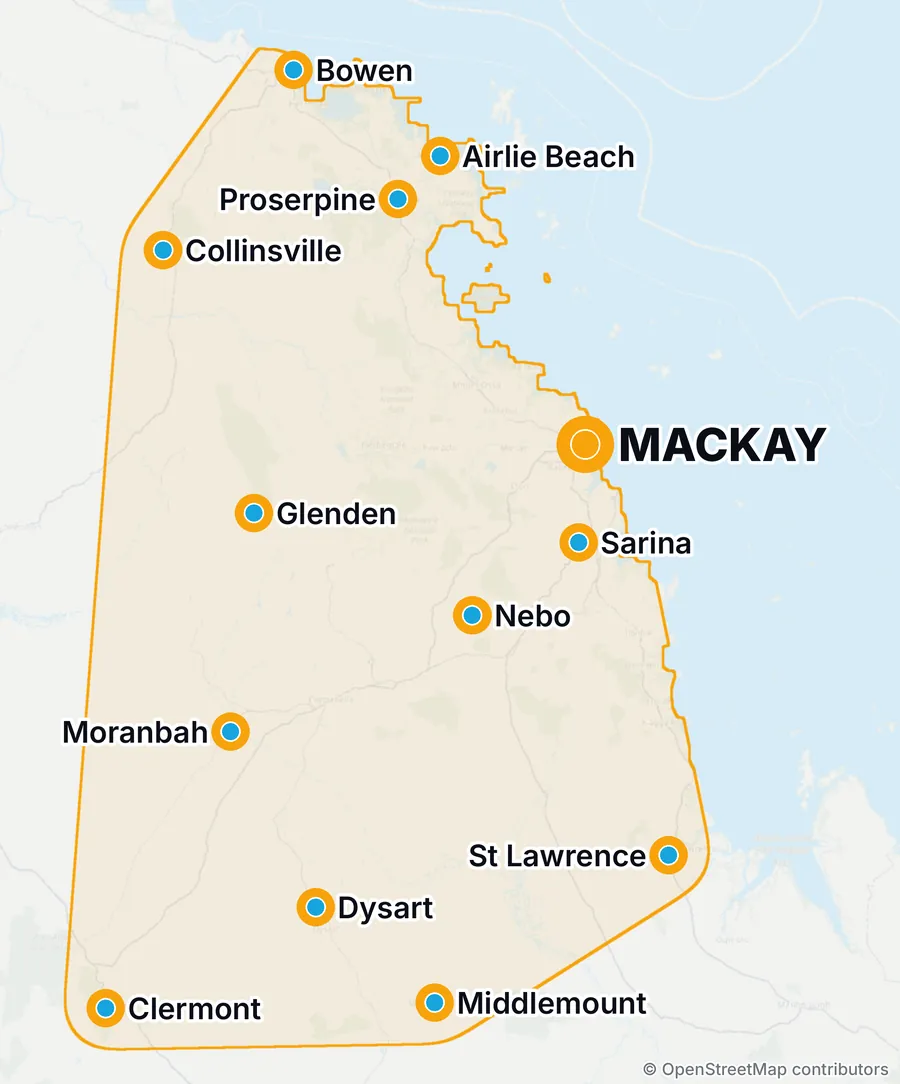
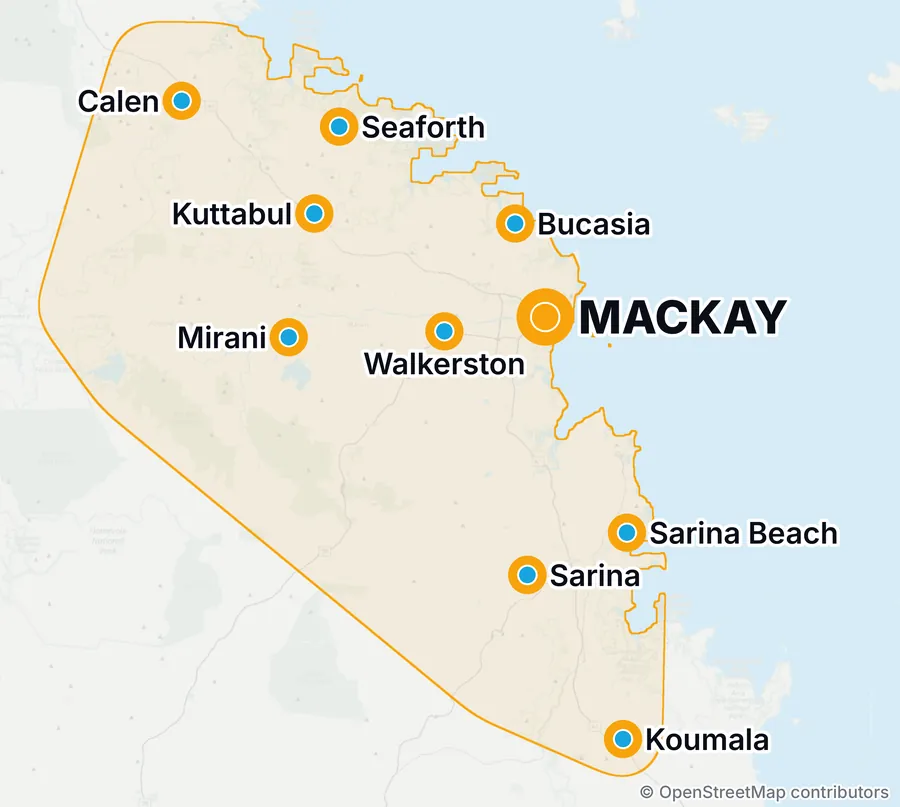
Next Phase Solar is a Mackay-based, family-owned business and part of NPT Group. Our team handles SME and light industrial work across Paget, Glenella, Mount Pleasant, East Mackay, Sarina and out to Bowen Basin sites including Moranbah and Dysart. The electrical work on every system is done by a licensed electrician. See our commercial solar service for what an install involves, and our commercial electrical work if the switchboard needs attention first.
Book a commercial solar assessment
Last reviewed July 2026.