
Last updated: October 2026 · Next Phase Solar team
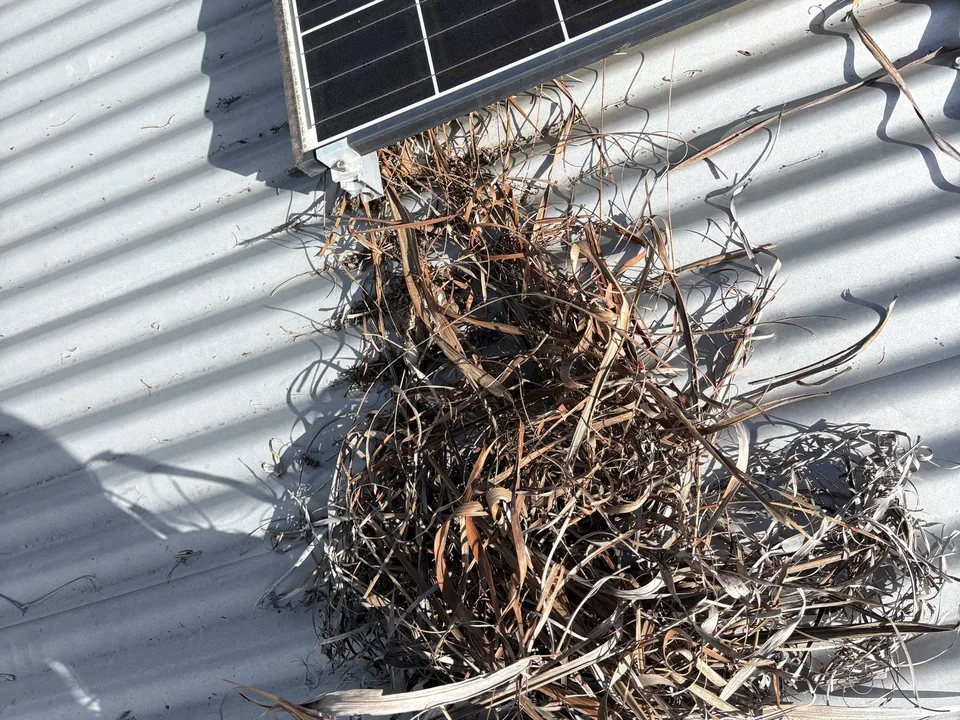
Pigeons and mynas love the warm, dry gap under solar panels. Once they move in, you get nests, sticks and droppings on the roof and in the gutters. Bird mesh around the edge of the panels closes that gap. The hard part is choosing the mesh, because the labels on most kits don’t tell you what you are actually buying.
This guide explains the materials, what the labels really mean and how to check a kit before it goes on your roof.
Why the material matters so much
Bird mesh lives on a hot roof, in full sun and rain, for as long as the panels stay up, which is many years. A mesh that rusts in a few years leaves orange streaks down your roof, weakens at the clips and eventually lets the birds back in.
On the coast, salt in the air speeds all of this up. The same mesh that lasts for years in Toowoomba can rust much faster a short walk from the beach. So the right mesh depends on two things: what the wire is made of, and where you live. This post covers the first. Our guide to coastal corrosion zones in Queensland covers the second.
The seven materials you will see
| Material | What it is | How it handles rust | Labels you will see | Best use |
|---|---|---|---|---|
| Plain carbon steel with PVC | Ordinary low carbon steel wire dipped in PVC | Fine while the PVC is intact. Cut ends and cracks rust quickly, with no zinc underneath to slow it down | “PVC coated”, “rust proof”, “black wire mesh” | Short term, inland, tight budget only |
| Galvanised steel with PVC | Steel wire with a zinc coat, then PVC | The zinc delays rust at cut ends for a while, then it rusts | “Galvanised PVC coated”, “hot dip galvanised” | Inland, and some coastal areas further from the sea |
| Galvanised steel, uncoated | Zinc coated steel, silver | The zinc wears away, faster near salt | “Galvanised weldmesh” | Inland only |
| 304 stainless with black PVC | 304 stainless wire with a black PVC coating | Does not rust through. Near the surf it can show surface staining | “SUS304”, “304 stainless PVC coated” | Most of Australia, including much of the coast |
| 304 stainless, uncoated | Silver stainless | Same as above, but more visible on the roof | “304 welded mesh” | Where looks don’t matter |
| 316 stainless | A higher alloy stainless that contains molybdenum | Best resistance to salt, with minimal staining | “316”, “marine grade” | Within about 5 km of the surf, and beachfront homes |
| Plastic or polyethylene mesh | A plastic grid | No rust, but sunlight breaks it down and animals can chew it | “PE mesh”, “plastic bird net” | Not recommended for the long term |
Plain carbon steel with PVC
Cut ends rust quickly, with no zinc underneath to slow it down
Galvanised steel with PVC
The zinc delays rust at cut ends for a while, then it rusts
304 stainless with black PVC
Does not rust through, even at a cut end
What the labels really mean
“Rust proof” and “not galvanised”
Neither of these is a grade of steel. A kit can honestly be described as “not galvanised” because it is plain carbon steel, which is the cheapest wire there is. “Rust proof” usually refers to the PVC coating: while the coating is perfect, water can’t reach the steel. The problem is what happens when it isn’t perfect.
“PVC coated”
PVC is a plastic skin. On stainless steel it gives a black finish that blends with the panel frames. On plain steel it is the only thing between the wire and the weather. Every time you cut the mesh to length, you expose bare steel at the cut. Every time it rubs against a roof sheet or a frame in the wind, or cracks in the sun after a few summers, the steel underneath is open to the air.
Watch out: Plain carbon steel with a PVC coat rusts faster than galvanised steel once the coating is cut or cracked, because there is no zinc layer underneath to protect it. You cut the mesh at every corner and join when you fit it, so those cut ends are the first places to go.
“Galvanised”
Galvanised steel has a zinc coating. Zinc slowly sacrifices itself to protect the steel, so galvanised wire handles cut ends and scratches better than plain steel. But the zinc gets used up, and salt air uses it up faster. One Australian solar company, Why Solar, says cheap galvanised mesh can rust “within a couple of years”. That is their claim, not an independent test, but it matches what the corrosion guides say about zinc near the coast.
“Stainless steel”, “SUS304” and “316”
Stainless steel contains chromium, which forms a thin, self repairing film on the surface. That is why it resists rust in its own right, with or without a coating. The two grades you will see on bird mesh:
- 304 is the common grade. It suits most homes, including many coastal suburbs.
- 316 has molybdenum added, which makes it much more resistant to salt. The Australian Stainless Steel Development Association (ASSDA) says grade 316 or equivalent “should be selected as a minimum within five kilometres of the surf”.
“Marine grade”
This usually means 316. If a seller says “marine grade”, ask them to confirm the grade number in writing.
Why the PVC coating doesn’t stop rust on its own
This is the point most kits gloss over, so it is worth saying plainly.
On stainless mesh, the PVC is mostly cosmetic. If it scratches, the stainless underneath still doesn’t rust through.
On plain steel mesh, the PVC is the whole defence. Three things break it:
- Cutting. Every cut leaves bare steel. A typical home needs several cuts, one at each corner and join.
- Sun. Years of UV on a hot roof make plastic brittle. Cracks let water in.
- Movement. Wind makes the mesh rub against the roof and the frame, and the coating wears through.
Once water reaches plain steel, rust spreads under the coating, where you can’t see it, until orange streaks show on the roof.
Stainless and “tea staining” near the sea
Even stainless can show light brown marks on the surface near the surf. ASSDA calls this “tea staining”. It is surface discolouration, not the wire rusting through. ASSDA notes that 304 and 430 are “lower alloyed and less expensive grades” that “will probably become tea stained” in marine environments, and that the risk can reach 20 km or more inland depending on wind, shelter and other conditions.
That is why 316 is the grade to choose close to the surf. It is the difference between mesh that stays clean and mesh that slowly picks up brown marks.
Tip: If you live near the water and already have 304 mesh, a rinse with fresh water when you wash your panels helps keep tea staining down.
The magnet test
You can’t see the grade of a wire by looking at it, especially under black PVC. A magnet helps.
| What the magnet does | What it probably means |
|---|---|
| Strong pull, the magnet snaps on | Plain carbon steel or galvanised steel |
| Weak pull | Stainless steel. 304 that has been bent or worked during manufacture can be slightly magnetic |
| No pull at all | Stainless steel, or a non metal mesh |
Hold an ordinary fridge magnet against the wire as soon as the kit arrives, before you open everything up. If it snaps on firmly, the mesh is not stainless, whatever the box says. A weak pull doesn’t prove it is 316, so for coastal homes, still ask for the grade in writing.
Strong pull
Plain carbon steel or galvanised steel
Weak pull
Stainless steel. Worked 304 can be slightly magnetic
No pull at all
Stainless steel, or a non metal mesh
Other specs that matter
| Spec | What to look for | Why |
|---|---|---|
| Aperture (the hole size) | About 11.5 to 12.7 mm | Stops pigeons, mynas and rats, while still letting air through |
| Wire thickness | 0.7 to 1.0 mm before coating | Thinner is easier to shape. Thicker is stiffer and tougher |
| Height (roll width) | 150, 200, 205 or 250 mm | Must cover the gap from the roof to the panel frame, with some overlap. Tiled roofs often need more |
| Roll length | 30 m or 40 m | A typical home with 10 to 20 panels |
| Coating | UV stabilised black PVC | Blends with the panel frames |
| Fixings | Clip on: J hooks with washers, or purpose made clips | Drilling the panel frame can void the panel warranty |
| Clip material | Aluminium, stainless or UV stabilised nylon | Nylon is cheaper but is plastic. Stainless lasts longest |
| Corner and join ties | UV rated cable ties or stainless ties | Ordinary plastic ties break down in the sun |
Tip: Measure the gap between your roof and the bottom of the panel frame before you buy. If the roll is too narrow, birds get in over the top or under the bottom.
Fixings: clip it, don’t drill it
How the mesh is held on matters as much as the mesh itself. Good kits use clips that hook onto the edge of the panel frame and hold the mesh against it. No holes are drilled.
Drilling into the panel frame can void the panel warranty. Check your panel maker’s installation manual before you fit anything to the frame. If a kit or an installer plans to drill, ask why.
Buyer’s checklist
Use this before you buy a kit or accept a quote:
- Ask for the stainless grade in writing. 304 or 316. “Rust proof steel” is not a grade.
- Do the magnet test when the kit arrives.
- Match the grade to your distance from the surf. Under about 5 km, 316. Coastal beyond that, 304. Inland, 304, or galvanised with PVC on a budget.
- Check the roll height against the gap under your panels.
- Choose clip on fixings. Avoid anything that drills the frame.
- Check what the clips are made of. Aluminium or stainless outlast nylon.
- Check the warranty and who gives it. Is it the manufacturer, the seller or the installer, and how many years?
- Clean first. Panels, nests and droppings should be dealt with before the mesh goes on.
What we fit
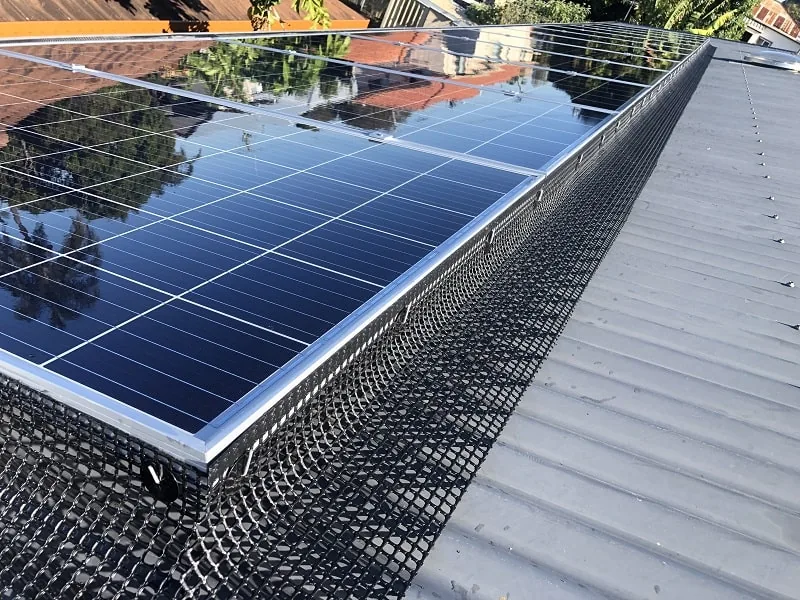
We fit 304 stainless steel mesh with a UV stable PVC coating, clipped to the panel frame, no drilling. Our installs come with a 3-year workmanship warranty, plus a 5-year warranty on the mesh. If your home is in the first rows back from the beach, talk to us about the right grade before you book.
Frequently asked questions
Is “rust proof” bird mesh the same as stainless steel?
No. “Rust proof” usually describes a PVC coating on ordinary steel. Stainless steel is a specific material, sold by grade, usually 304 or 316. Ask the seller for the grade in writing.
Does a PVC coating stop bird mesh from rusting?
Only while it is intact. Cutting the mesh to length, sun damage and rubbing in the wind all expose the steel. On plain steel, rust then spreads under the coating. On stainless, the coating is mostly for looks.
Should I choose 304 or 316 stainless mesh?
304 suits most homes. ASSDA recommends 316 as a minimum within about 5 km of the surf. If you are unsure, choose the higher grade.
How can I tell if my mesh is really stainless?
Try a fridge magnet. A strong pull means plain or galvanised steel. A weak pull or none suggests stainless. Worked 304 can be slightly magnetic, so a weak pull is normal.
Will drilling bird mesh clips into my panels void the warranty?
It can. Drilling the panel frame can void the panel warranty. Use clip on fixings and check your panel maker’s installation manual.
Read next
- Why bird proof your solar panels? A plain English guide
- Which bird mesh for your area: coastal corrosion zones explained
- Bird proofing solar panels: DIY kit or professional installation?
- How to install a solar panel bird mesh kit, step by step
- Panels dirty under the birds? A Solar Health Check cleans them and checks every panel with a thermal camera.