
Last updated: October 2026 · Next Phase Solar team
If you have solar panels and you hear cooing on the roof in the morning, there is a good chance birds are living under your panels. This guide explains, in plain English, what is going on up there, why it matters and how bird proofing fixes it. The photos are from real Mackay roofs we have worked on.
What is actually happening under your panels
Solar panels sit on rails a little above the roof. That leaves a gap between the panel and the roof sheets, open on every side.
From a bird’s point of view, that gap is ideal. It is shaded in summer, dry when it rains, sheltered from the wind and hard for anything to reach. Pigeons and mynas love it.
The problem is what else lives in that gap. The cables from your panels, and the plugs that join them, run along under the panels, right where the birds build.
- Warm, dry and out of the wind
- Your cables and connectors run here
- Nest, leaves and droppings pile up here
Five things birds do to your solar and your home
- Droppings shade your panels
- Nests and leaves by the cables
- A health risk if disturbed
- Mess on the roof and gutters
- It doesn’t fix itself
1. Droppings shade your panels
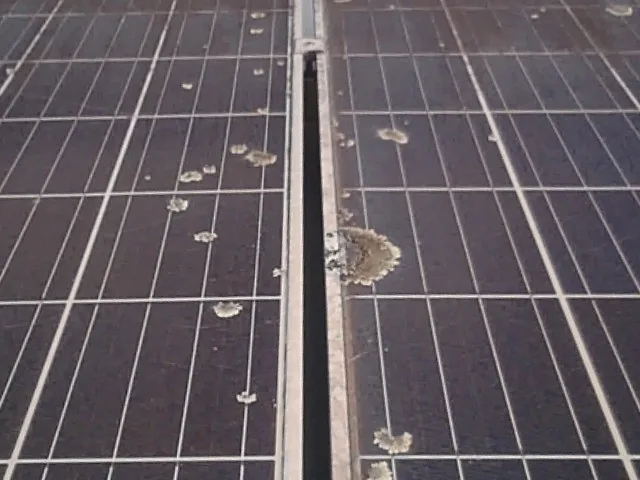
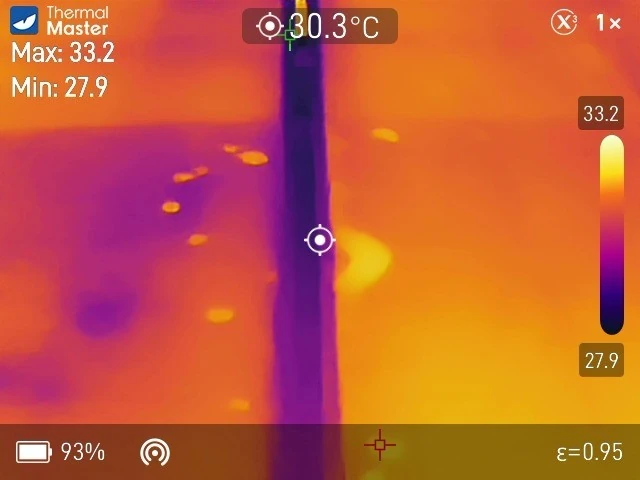
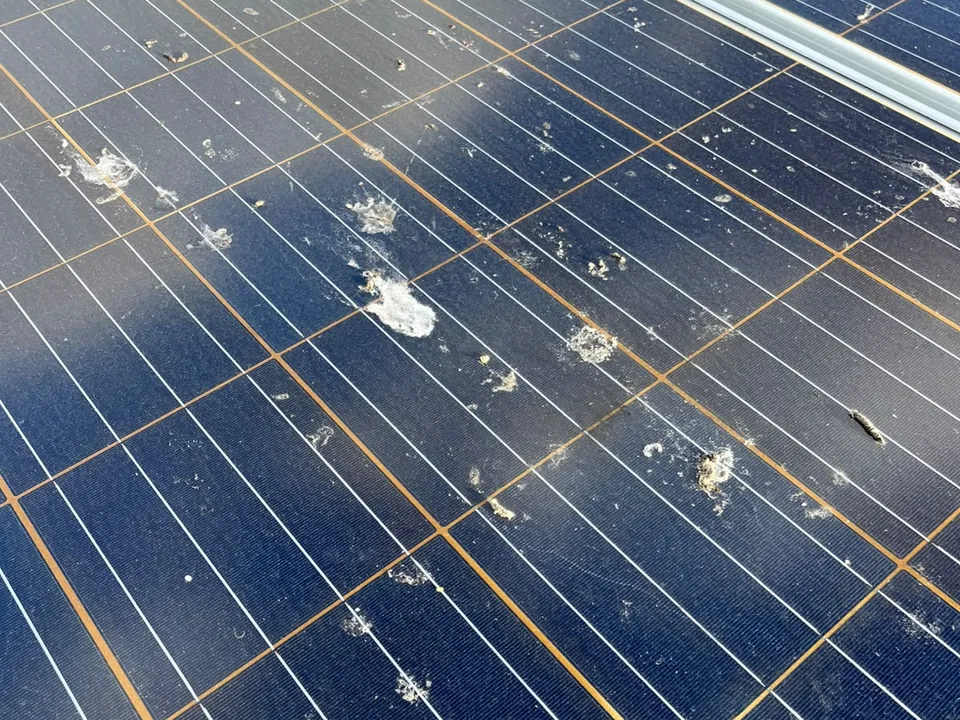
A solar panel is made of cells, and each cell needs light to make power. Bird droppings on the glass block the light to the cell underneath. That cell makes less, and it runs warmer than the cells around it.
You can see this on a thermal camera. The photo below is from one of our Solar Health Checks in Mackay, taken before the clean. On the left is the panel, with lichen and bird droppings on the glass. On the right is the same spot on the thermal camera. Each patch shows up warmer than the clean glass around it.
A clean washes the droppings off. But while the birds live there, the droppings come back, so the panels keep getting dirty between cleans.
2. Nests and leaves pile up next to the cables
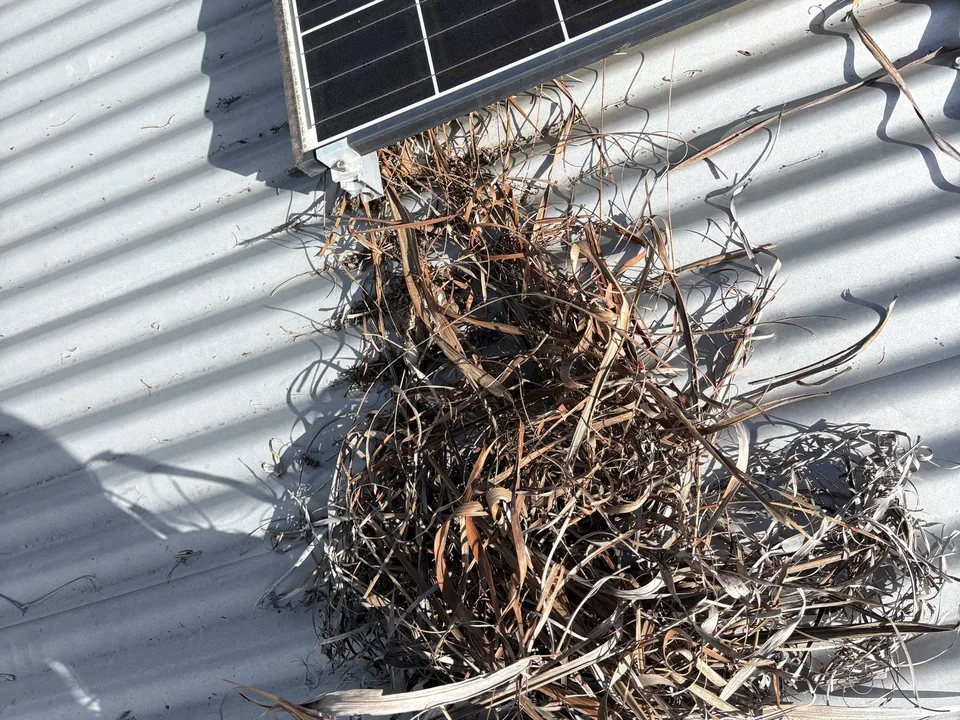
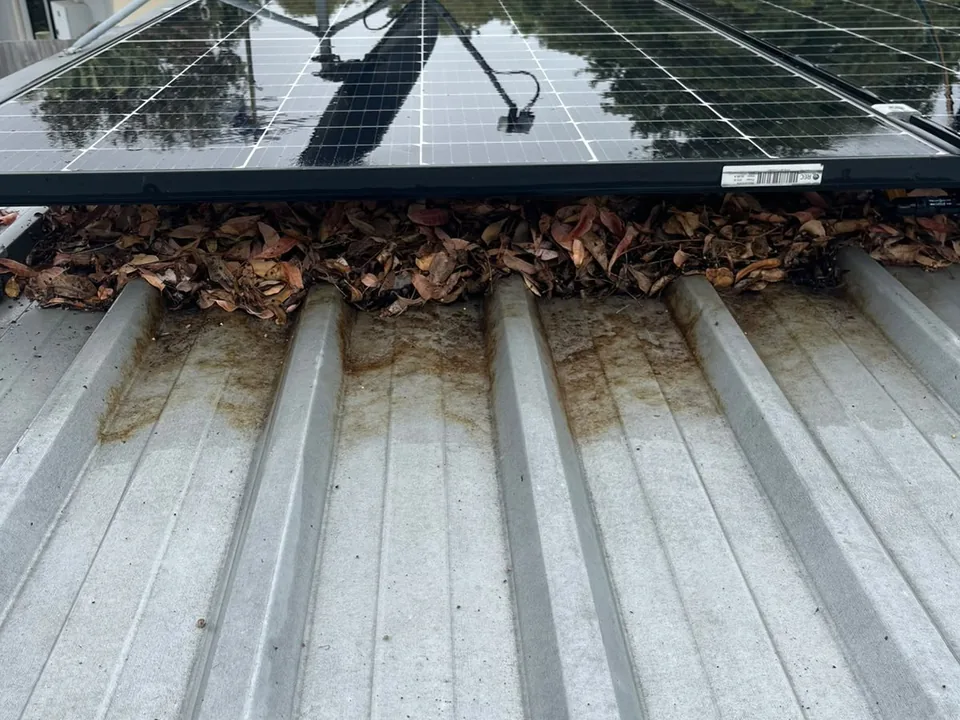
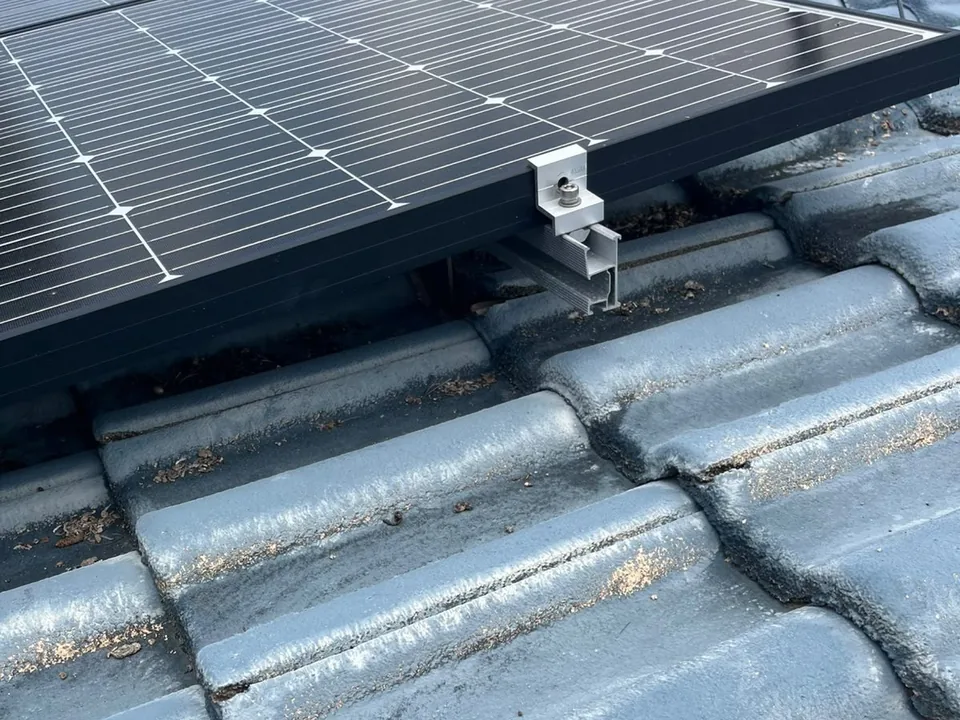
Birds carry in sticks and dry grass for their nests. Leaves blow in under the open edges too. Over time, the gap fills up with dry material, sitting right beside the cables and the connectors that join your panels.
We are not saying birds set solar panels on fire. Most of the time nothing happens. But dry nests and leaves are fuel, and they are the last thing you want next to the wiring of your power system. The Australian Government’s National Emergency Management Agency says that a rooftop solar frame should “enable any leaf litter to be cleaned out easily”, as part of keeping a home safe from bushfire embers.
3. Dry droppings are a health risk if you disturb them
Bird droppings carry germs. WorkSafe Queensland explains that the risk from a small amount of fresh droppings is very low, but it grows when large amounts of dried droppings are disturbed, because the dust gets into the air. It lists diseases linked to bird droppings, including psittacosis, histoplasmosis and cryptococcosis.
Under solar panels, droppings build up in exactly that way: a lot of them, in one place, drying out in the heat. So this is not a job for a broom and a dustpan. Don’t dry sweep it and don’t blast it with a hose.
Watch out: if there is a big build up of droppings under your panels, don’t clean it out yourself. Leave it for someone with the right gear.
4. Mess on your roof, gutters and patio
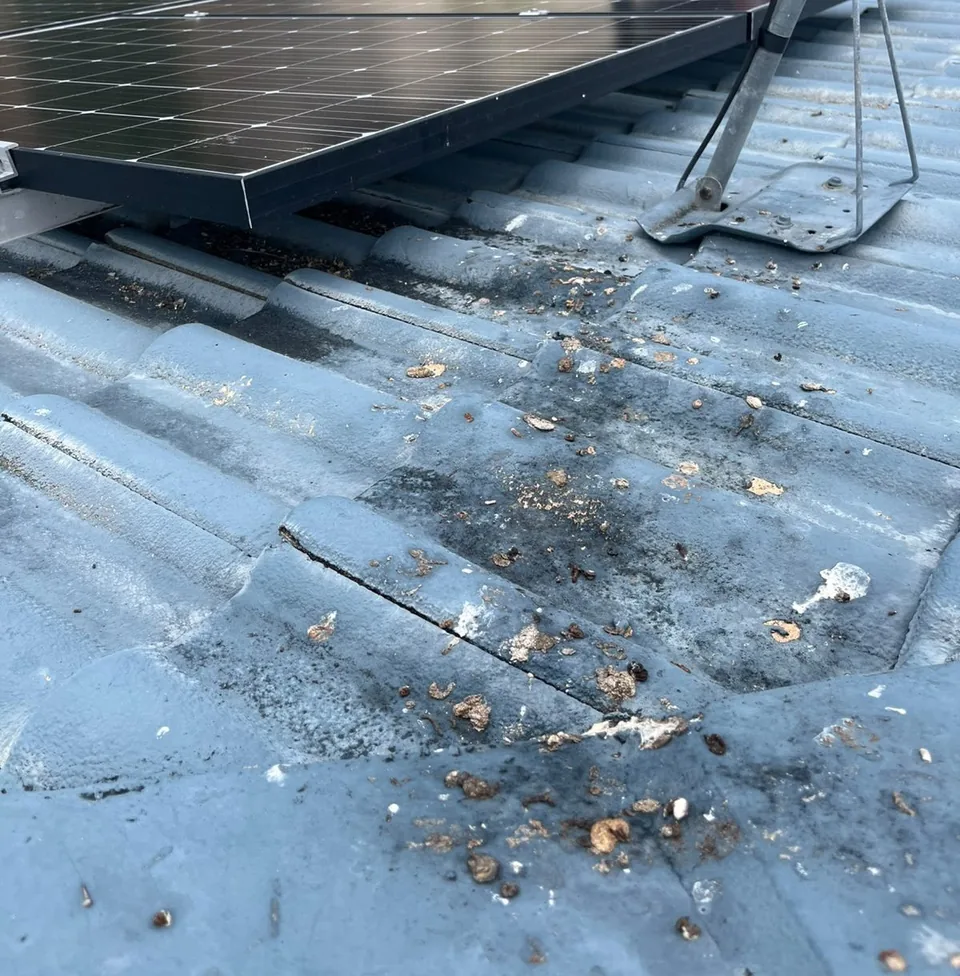
What the birds bring in has to go somewhere. Droppings, husks and nest material wash down the roof in the rain, into the gutters and over the edge onto paths and patios. Leaves under the panels also hold water against the roof sheets, which can leave rust coloured staining, like in the photo of the leaves in point 2.
5. It doesn’t fix itself
Cleaning out a nest without closing the gap leaves the gap open, so the birds can simply move back in. The lasting fix is to close the gap.
The signs to look for
You don’t need to get on the roof to know. Look for:
If you see any of these, birds are probably already living under your panels.
How bird proofing fixes it
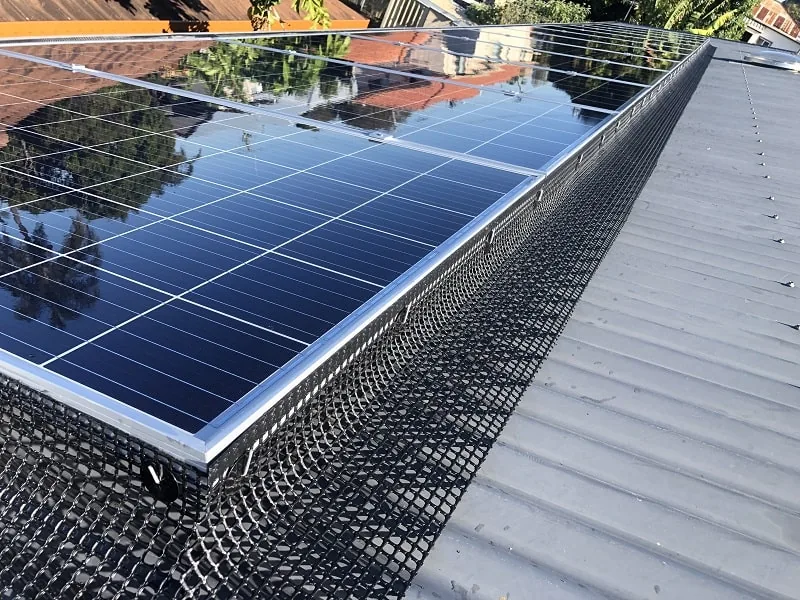
Bird proofing closes the gap. A strip of mesh goes all the way round the edge of each block of panels, from the panel frame down to the roof. The birds can’t get in, and leaves and sticks can’t blow in under the edges.
- Mesh clipped to the panel frame
- Nothing drilled into the panel or the roof
- Air still flows through the mesh
What we use
- 304 stainless steel mesh with a UV stable PVC coating. Stainless steel resists rust in its own right, and the coating keeps it black so it blends in with the panels. Our guide to choosing bird mesh explains why the steel grade matters.
- Clips on the panel frame. Nothing is drilled into your panels or your roof. Drilling a panel frame can void the panel warranty.
- Open mesh. Air still moves under the panels, so they keep cooling the way they were designed to.
What a bird proofing job looks like
We check the roof and the gap under every panel before anything is touched.
We clear the nests and droppings from under the panels first.
We fit the mesh all the way round every block of panels, so there are no gaps for the birds to find.
We clip it to the panel frame. No drilling.
You get the warranty in writing: 3 years on our workmanship, and we warrant the mesh for 5 years. If birds ever get back in through a spot we closed, we fix it free.
How the price is worked out
The price depends on how much mesh your panels need, which is the distance all the way round the edge of each block of panels. That is why the booking page asks how your panels are laid out.
One row of 6 panels
about 18 m
Two rows of 10 panels
about 31 m
This line is what we measure
As a guide, one row of 6 panels needs about 18 m of mesh, and 20 panels in two rows of 10 need about 31 m. Your price shows online before you book, and it is fixed when you book. We check your roof on satellite before the visit: if it doesn’t match what you picked, we tell you the new price first, and you can cancel free.
Two storey homes and tile roofs can be done too. Tile roofs and jobs that need scaffolding are priced with a quick call first.
Can I do it myself?
You can buy bird mesh kits online, and some people fit them. The hard parts are not the mesh. They are working safely on the roof, cleaning out the droppings without breathing in the dust, choosing a mesh that won’t rust, and not sealing in a protected native bird. Our guide to DIY kits or a professional job goes through it honestly, with the costs.
Frequently asked questions
Will the mesh hurt the birds?
No. The mesh keeps them out, it doesn’t trap them. We clear the gap before the mesh goes on, so nothing is closed in. Native birds are protected in Queensland, and an active nest of a native bird must not be disturbed without an authority. If we find one, we leave it and talk to you about it.
Will my panels get hotter with mesh around them?
No. The mesh is open, so air keeps moving under the panels.
Will bird proofing void my panel warranty?
Not when the mesh is clipped to the frame, which is how we fit it. Drilling into a panel frame is what can cause warranty problems.
Do I need a panel clean as well?
It is worth doing at the same time. Once the birds are out, a clean takes off the droppings that are already on the glass.
Can you bird proof a tile roof or a two storey home?
Yes. A two storey home costs a little more. Tile roofs and anything that needs scaffolding are priced with a quick call before we book.
How long does the mesh last?
We use 304 stainless steel with a UV stable coating, and we warrant the mesh for 5 years, plus 3 years on our workmanship.
Ready to get the birds out?
You choose your layout online and see your price before you book. And if birds ever get back in through a spot we closed, we fix it free.
Read next
Sources
- National Emergency Management Agency: Keep your house renovations bushfire safe (last updated 12 December 2024)
- WorkSafe Queensland: Work with bird and bat droppings
- Queensland Government: Species management program information sheet
- Next Phase Solar Website and Booking Terms, section 11 (warranty), October 2026.
- Photos and thermal scan: Next Phase Solar Solar Health Checks in Mackay, September and October 2026.