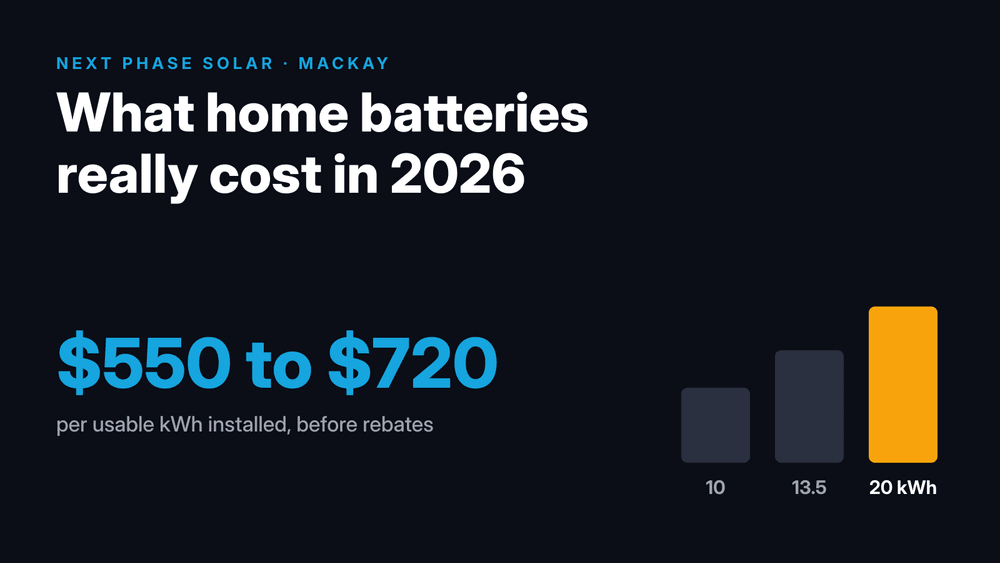
The honest answer: in 2026 a quality home solar battery in Australia costs roughly $7,000 to $11,000 installed for the common 10 to 13.5 kWh size, after the federal rebate. That works out to about $550 to $720 per usable kWh. Below is the full breakdown by size, by brand, and the things that move the price up or down.
The short version
A 10 kWh battery lands around $7,000 to $10,500 installed after the federal rebate. A 13.5 kWh Tesla Powerwall 3 runs about $10,000 to $12,500 after rebate. Per usable kWh, expect roughly $550 to $720 installed, with the price per kWh dropping as the battery gets bigger.
What a battery costs by size
These are installed prices for a quality battery from an accredited installer, not battery-only supply prices.
| Battery size | Before federal rebate | After federal rebate |
|---|---|---|
| 10 kWh | $10,000 to $14,000 | $7,000 to $10,500 |
| 13.5 kWh (Powerwall 3) | $13,500 to $16,000 | $10,000 to $12,500 |
| 20 kWh | $14,000 to $18,000 | $9,000 to $12,000 |
The most common install is the 10 to 13.5 kWh band, which is enough to cover the evening and overnight load of a typical family home.
The federal rebate that changed the maths
Since 1 July 2025 the federal Cheaper Home Batteries Program has discounted battery storage at the point of sale, through Small-scale Technology Certificates based on usable capacity.
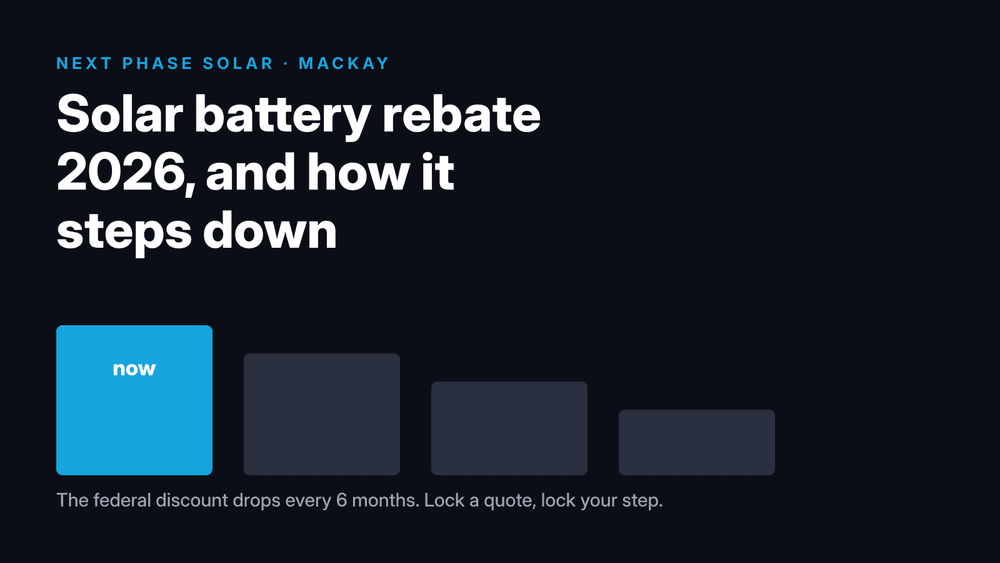
The discount steps down over time. Until 30 April 2026 it was worth around $335 per usable kWh. From 1 May 2026 it dropped to roughly $250 per usable kWh, and it now steps down again every six months through to 2030. On a 10 to 13.5 kWh battery that is about $2,500 to $4,000 off, applied upfront so you never handle the paperwork.
Two rules matter:
- The rebate is tiered from 1 May 2026. You get the full rate on the first 14 kWh of usable capacity, 60 percent from 14 to 28 kWh, 15 percent from 28 to 50 kWh, and nothing above 50 kWh.
- You can only claim it once per property, and the battery must be paired with solar, either existing or installed at the same time.
Because the rebate shrinks every six months, waiting costs you money. The hardware does not get cheaper fast enough to make up for a smaller rebate.
Why two batteries the same size cost different amounts
- All-in-one versus battery only. A Tesla Powerwall 3 has a solar inverter built in. A Sungrow or BYD battery is storage only and needs a separate compatible hybrid inverter, which changes the total system cost. Comparing a battery-only price against an all-in-one price is not a fair comparison.
- Backup capability. Whole-home or essential-circuit backup during a blackout often needs extra hardware. In North Queensland, where cyclones and outages are a fact of life, this is worth specifying.
- Install complexity. Switchboard upgrades, cabling runs and mounting location all add labour.
Be careful with prices that look too cheap
You will see “installed from $3,900” style numbers online. Those are almost always battery-only supply prices or heavily discounted package deals, not a fully installed system with an inverter, switchboard work and an accredited sign-off. For an honest budget, use the $7,000 to $11,000 after-rebate band for a 10 to 13.5 kWh battery.
What about payback?
Payback in 2026 typically runs about 5 to 8 years on bill savings alone, and it is shortest in states with high power prices and low feed-in tariffs, which includes Queensland. Payback is the most assumption-sensitive number on this page. It depends on your electricity price, how much solar you export today, and how much you use in the evening. Treat any single payback figure with caution and ask to see the workings.
Frequently asked questions
How much does a 10 kWh solar battery cost in Australia in 2026?
About $10,000 to $14,000 installed before the federal rebate, and roughly $7,000 to $10,500 after it. The price per usable kWh falls as the battery gets bigger.
Is it worth waiting for batteries to get cheaper?
Probably not. The federal rebate steps down every six months from 1 May 2026, and battery hardware is not falling in price fast enough to offset a smaller rebate. Installing earlier in a rebate period locks in a larger discount.
Can I get the battery rebate without solar?
No. The Cheaper Home Batteries Program requires the battery to be paired with a solar system, existing or new. A battery on its own does not qualify.
How long until a solar battery pays for itself?
Generally 5 to 8 years on bill savings, before you count blackout backup. Homes with high evening usage and a time-of-use tariff sit at the shorter end.
Sources
- Cheaper Home Batteries Program, DCCEEW
- Battery rebate values and the 1 May 2026 changes, Solar Choice
- Installed battery cost ranges, SolarQuotes
What to do next
If you are weighing up whether a battery makes sense for your home, our honest cost-benefit guide goes deeper on the numbers: Are home batteries worth it in Mackay in 2026?
Next Phase Solar designs and installs battery systems across Mackay and the region, sized against your actual Ergon bills and signed off by a Queensland licensed electrician.
Get a battery quote with real numbers at /quote
Last reviewed June 2026.