
The solar battery rebate in 2026 is the federal Cheaper Home Batteries Program, and it is the only battery rebate running in Australia right now. It takes roughly 30 percent off the installed cost of an eligible home battery, worth about $260 per usable kWh nationally from 1 May 2026, and it comes straight off your invoice at the point of sale rather than as a cheque you chase later. It is not means tested, the battery has to be paired with solar, and the rate steps down on a fixed calendar until the scheme closes at the end of 2030. So the honest headline is short: the discount is real, it is generous today, and it only gets smaller from here.
Next Phase Solar installs out of Mackay, Queensland, and we handle the certificates on every eligible job, so the discount reaches you as a lower invoice rather than as paperwork. Call (07) 4957 3511 if you want it worked out on your own system.
The short version
- One rebate applies nationally. The federal Cheaper Home Batteries Program discounts a battery through the Small-scale Renewable Energy Scheme (SRES), the same certificate system that already discounts rooftop solar.
- It is worth about $260 per usable kWh from 1 May 2026, which is 6.8 certificates per usable kWh at an STC price near $38.30, applied upfront by your installer. You never lodge paperwork.
- It is a single national factor. Unlike rooftop panels, the battery incentive does not change with your postcode zone. The only thing that moves your quoted figure is the certificate spot price on the day.
- The factor drops from 6.8 to 5.7 on 1 January 2027, a 16 percent cut, and keeps stepping twice a year after that. On a 13.5 kWh battery that January change is worth $569.
- There is no state top-up. The Queensland Battery Booster grant closed to new applications in May 2024, so in 2026 the federal program stands alone.
How the federal solar battery rebate works
The rebate is paid as Small-scale Technology Certificates (STCs) created against your battery’s usable capacity. Your installer generates those certificates, sells them, and passes the value back to you as an upfront discount on the quote. That is why there is no rebate form and no waiting: the number you see on the invoice already has the discount baked in.
The rules that decide whether you qualify are straightforward:
- The battery must be paired with rooftop solar, either a system you already own or one installed at the same time. A battery on its own does not qualify.
- The battery and its inverter must be VPP-capable at installation. You do not have to join a virtual power plant, the hardware just has to be able to. Participation is optional.
- There is no means test, and it is claimed once per property.
- Eligible systems run from 5 kWh to 100 kWh of nominal capacity, but certificates are only created on the first 50 kWh of usable capacity. Usable capacity is read from the Clean Energy Council approved battery list, not the marketing brochure.
What you actually get in dollars
Because the incentive is calculated on usable kWh at a national factor, the maths is clean. At 6.8 certificates per usable kWh from 1 May 2026, about $260 at an STC price near $38.30, common home sizes land close to this:
| Usable battery size | Approx federal discount (from 1 May 2026) |
|---|---|
| 10 kWh | around $2,604 |
| 13.5 kWh (for example a Powerwall 3) | around $3,516 |
| 14 kWh (full-rate cap) | around $3,646 |
| 20 kWh | around $4,584 |
These are indicative. The certificate price floats, so your installer confirms the exact discount on the day they lock in the quote. The figure is the same anywhere in Australia, and our Queensland battery rebate guide covers why there is no zone loading on batteries even though there is one on panels.
The size taper: bigger is not proportionally better
Before 1 May 2026 the factor was flat across the whole battery. It is not any more. From that date the rebate tapers by capacity, so the value per kWh drops once you go past a mid-sized battery:
| Usable capacity band | STC factor applied |
|---|---|
| 0 to 14 kWh | 100% |
| more than 14 up to 28 kWh | 60% |
| more than 28 up to 50 kWh | 15% |
| above 50 kWh | nothing |
For most homes a 10 to 14 kWh battery sits entirely in the full-rate band, which is also the size that actually matches a typical evening load. Going much larger buys you a smaller rebate on every extra kWh and a longer payback. The taper is deliberate policy design to stop people oversizing on the public purse, and it is worth planning around rather than fighting.
It steps down on a fixed calendar
The federal rate is not locked in. It was set higher when the program launched and has been falling as battery prices fall, so the scheme keeps landing near that 30 percent discount rather than getting more generous. Here is the calendar that matters:
| Date | What happens |
|---|---|
| 1 July 2025 | Program starts at the full rate |
| 1 May 2026 | Faster step-down begins, the size taper is introduced, the factor settles at 6.8 per usable kWh, near $260 |
| 1 January 2027 | The factor drops from 6.8 to 5.7, a 16 percent cut, then 5.2 from July 2027 and twice-yearly steps to 2030 |
| End of 2030 | The scheme closes |
The takeaway is the part people get wrong: waiting does not grow the rebate, it shrinks it. Hardware is not getting cheaper fast enough to offset a falling factor, so the cheapest install is early in a rebate period.
How it stacks with your solar STCs
The panels and the battery are discounted separately, and if you install them together both discounts apply on the same job. Rooftop solar panels earn their own STCs under the SRES, deemed on system size and your postcode zone, and that solar discount also steps down every January until 2030. The battery earns its STCs on usable kWh at the national factor described above. There is no penalty for claiming both. Adding panels and a battery at the same time simply stacks the two upfront discounts on one invoice. If you want the panel side of that equation, our residential solar page covers what a system costs after its own STC discount.
Why storing beats exporting in regional Queensland right now
A rebate makes a battery cheaper. Your tariff decides whether it pays. And here the honest driver is not rising power prices. The Queensland Competition Authority’s 2026-27 determination actually cut regulated regional Queensland bills, by up to 6.9 percent for typical households. What has collapsed is the value of exporting your solar. The regional feed-in tariff has fallen hard:
| Ergon regional feed-in tariff | Rate |
|---|---|
| 2024-25 | 12.377 c/kWh |
| 2025-26 | 8.66 c/kWh |
| 2026-27 | 6.153 c/kWh |
When you export at about 6 cents but buy back in the evening at around 30 cents or more, every kWh you store instead of sending to the grid is worth far more to you than the export payment. That gap is the whole case for a battery in 2026.
The Ergon Tariff 12F Solar Sharer sharpens it further. It gives a free usage window from 11am to 2pm, up to 24 kWh a day, then charges its most expensive rate through the 4pm to 9pm peak. A battery lets you fill up for nothing at midday and run the house off stored power through that peak, which is exactly when a family is cooking and cooling. We break the tariff down in is the Ergon 12F Solar Sharer worth it, and we run the payback honestly in are home batteries worth it in Mackay in 2026.
Frequently asked questions
How much is the solar battery rebate worth in 2026?
From 1 May 2026 it is about $260 per usable kWh nationally, which works out to roughly $2,604 off a 10 kWh battery and around $3,516 off a 13.5 kWh battery. That is close to a 30 percent discount on the installed cost. The exact figure depends on the certificate spot price on the day your installer locks it in.
Do I have to apply for the solar battery rebate myself?
No. It is claimed at the point of sale. Your accredited installer creates and assigns the certificates, and the discount comes straight off your invoice. There is no form for you to lodge and no rebate cheque to wait on.
Can I get the solar battery rebate without solar panels?
No. The battery has to be paired with a rooftop solar system, either one you already have or one installed at the same time. A standalone battery is not eligible under the program, and without solar to charge it the economics do not stack up anyway.
Does the solar battery rebate get bigger if I wait?
No, it gets smaller. The rate stepped down on 1 May 2026 and then steps down again every January and July from 2027 through to the scheme’s close at the end of 2030. Installing earlier in a given period locks in the larger discount.
Sources
- The Cheaper Home Batteries Program is delivered through the expanded Small-scale Renewable Energy Scheme, which the Clean Energy Regulator administers, so the Clean Energy Regulator (linked below) is the official source for the eligibility rules, the 5 kWh to 100 kWh system range and the VPP-capable requirement. The certificate factors per usable kWh (8.4, then 6.8 from 1 May 2026, 5.7 from January 2027 and 5.2 from July 2027) and the absence of any geographic zone rating or multiplier for batteries come from the Clean Energy Regulator page linked below. The roughly 30 percent headline and point of sale delivery are set out in the SolarQuotes and Solar Choice sources. The Australian Government also runs a plain-language consumer explainer on energy.gov.au (Cheaper Home Batteries Program), cited here by name because that site blocks automated checking.
- Program eligibility, no means test and pairing with solar are covered by the Department of Climate Change, Energy, the Environment and Water (DCCEEW), the responsible department, cited here by name. The binding size taper bands and the step-down calendar to 2030 are set out in full on the Clean Energy Regulator page linked below.
- Official administrator of the Cheaper Home Batteries Program under the Small-scale Renewable Energy Scheme: the STC mechanism, usable capacity from the Clean Energy Council approved list, the 50 kWh certificate cap, the size taper bands (100 percent to 14 kWh, 60 percent to 28 kWh, 15 percent to 50 kWh) and the twice-yearly step-down to 2030: Clean Energy Regulator, Solar batteries.
- National per kWh value and the 1 May 2026 changes: Solar Choice, Federal Government Solar Battery Rebate and Changes from 1 May 2026.
- Point of sale mechanics and worked rebate figures: SolarQuotes, Federal Battery Rebate.
- The Queensland Battery Booster grant closed to new applications in May 2024, when its funding was exhausted, and its program page has since been retired, so it is cited here by name (Queensland Government, Battery Booster program) rather than by link.
- Regional Queensland feed-in tariff, 12.377 c/kWh for 2024-25, 8.66 c/kWh for 2025-26 and 6.153 c/kWh for 2026-27: QCA regional feed-in tariff 2024-25, 2025-26 and 2026-27.
- Regulated regional Queensland prices falling for 2026-27: QCA, Regulated electricity prices for regional Queensland 2026-27.
What to do next
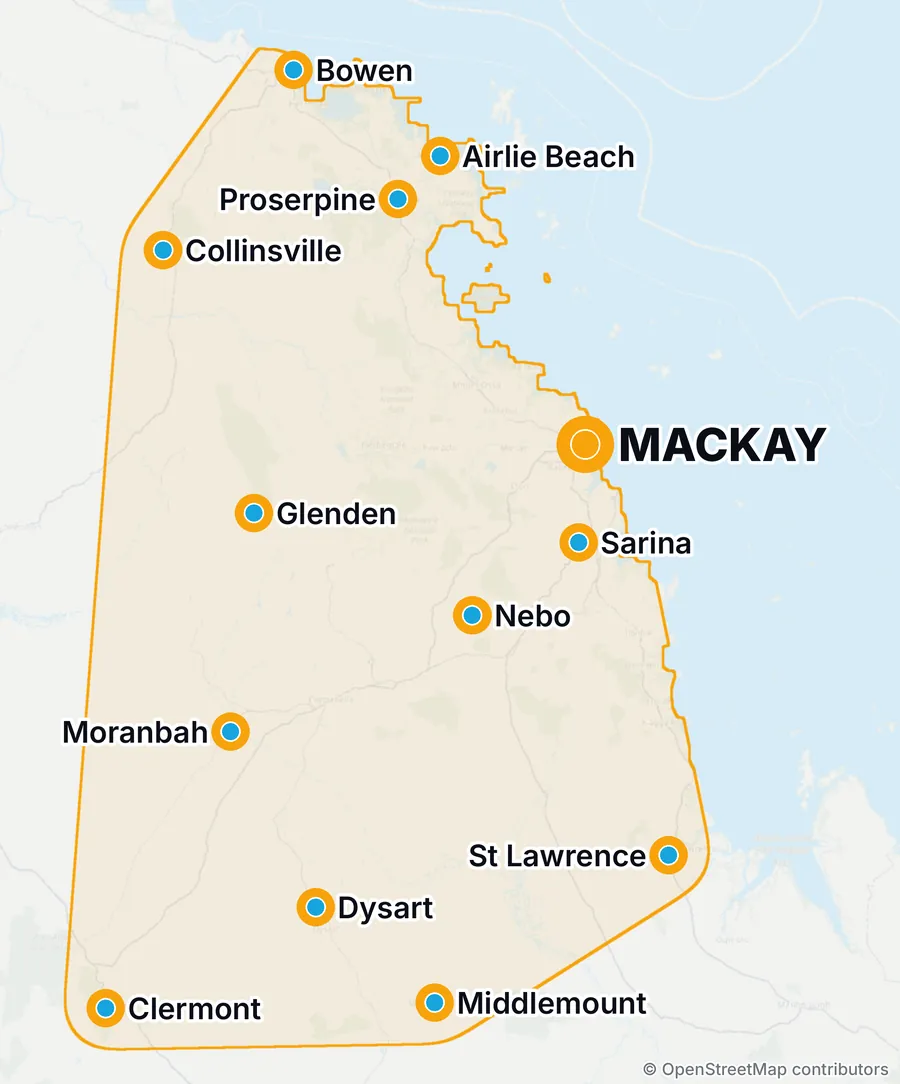
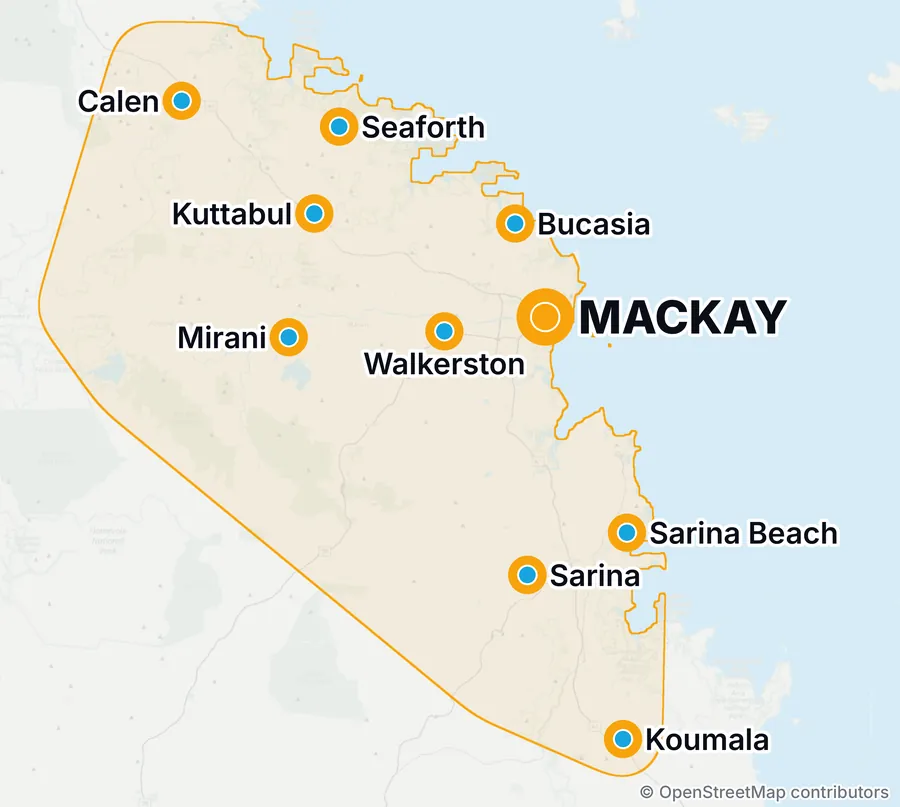
Next Phase Solar designs and installs home battery systems across Mackay and the region, sized against your real Ergon bills, with the federal rebate applied upfront and every install signed off by a Queensland licensed electrician. We will tell you straight whether a battery pays for your usage before you spend a cent.
Get a battery quote with the rebate already applied
Last reviewed July 2026. Rebate factors, tariff rates and fees change on the dates above. Confirm the current figures before you buy.