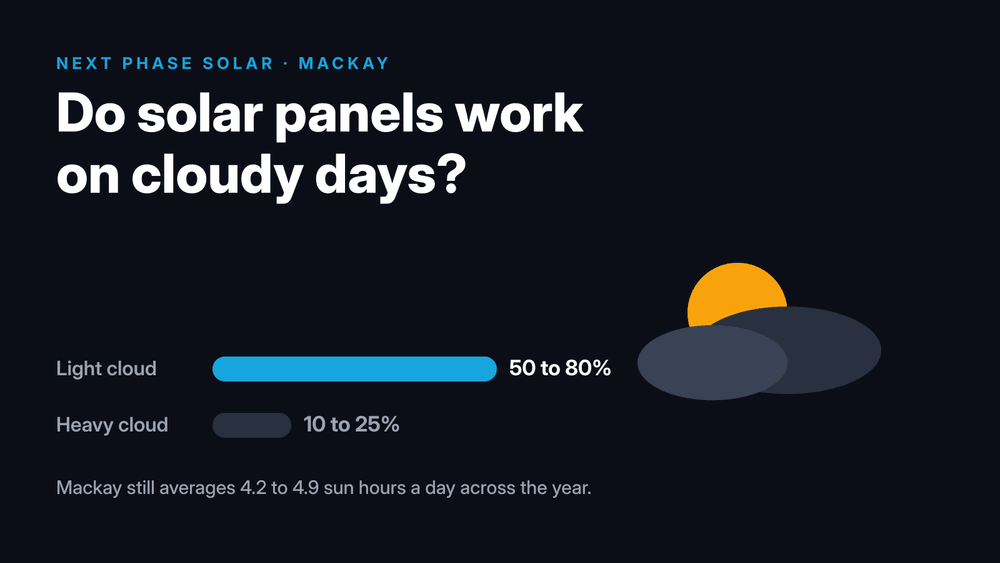
The honest answer: yes, solar panels still work on cloudy days. They run on daylight, not direct sun, so they keep generating when it is overcast, just at a reduced rate. On a lightly cloudy day you might get 50 to 80 percent of normal output, and on a dark, heavily overcast day more like 10 to 25 percent. They produce almost nothing at night.
The short version
Cloud lowers output, it does not switch panels off. Across a full year the cloudy days are already built into how a system is sized, so a well-sized system still covers your needs. In Mackay the thing to plan for is the wet season, not the odd grey day.
How much output you get in cloud
- Light cloud or haze: roughly 50 to 80 percent of a clear day. You often will not notice the difference on your bill.
- Heavy, dark overcast: roughly 10 to 25 percent. Still real generation, just much less.
- Rain: similar to heavy cloud for output, with a bonus, rain rinses dust off the panels, which can lift performance once the sun returns.
Because output depends on daylight reaching the panel, even a bright overcast sky carries enough diffuse light to keep a system producing.
What this means for the Mackay wet season
Mackay gets a genuine wet season, roughly December to March, with stretches of heavy cloud and rain. Two things keep solar worthwhile here anyway. First, the same months bring long daylight hours and strong light between the downpours, so generation is still high across the season. Second, a system is sized on your yearly average, which already accounts for the cloudy spells. We size against twelve months of your real usage, so the wet season is in the numbers, not a surprise.
If you want to ride through a run of dark days using your own power, that is a battery question rather than a panel question. A battery stores your sunny-hour surplus to use later, which smooths out a grey patch. We cover that in is solar worth it and in our battery sizing guidance.
Do not confuse cloud with dirt
A grey day is temporary. A dirty panel is a permanent drag until you clean it, and in Mackay pollen, salt and cane dust build up fast. If your output is low even on clear days, the panels may simply need a wash. We explain that in why Mackay panels need cleaning more often.
Frequently asked questions
Do solar panels work on cloudy days?
Yes. Panels run on daylight, so they keep generating when it is overcast, at a reduced rate. Expect roughly 50 to 80 percent of normal output in light cloud and about 10 to 25 percent in heavy, dark overcast.
Do solar panels work in the rain?
Yes, at a reduced rate similar to heavy cloud. Rain also rinses dust off the panels, which can improve performance once the sun comes back.
Will solar still be worth it through the Mackay wet season?
Yes. The wet season has long daylight hours and strong light between showers, and a system is sized on your yearly average, which already includes the cloudy months. A battery can help you ride through a run of grey days on your own power.
Do panels produce power at night?
No. Panels need daylight, so they produce almost nothing at night. To use solar after dark you need a battery to store the day’s surplus.
Sources
- How solar output varies with weather, energy.gov.au
- Cloud and solar performance, SolarQuotes
What to do next
If cloud was your main worry, the next questions are sizing and value. See what size solar system and battery you need and is solar worth it.
Next Phase Solar sizes systems for Mackay homes against a full year of your Ergon data, so wet-season cloud is already accounted for.
Get a system sized for real Mackay conditions at /quote
Last reviewed June 2026.