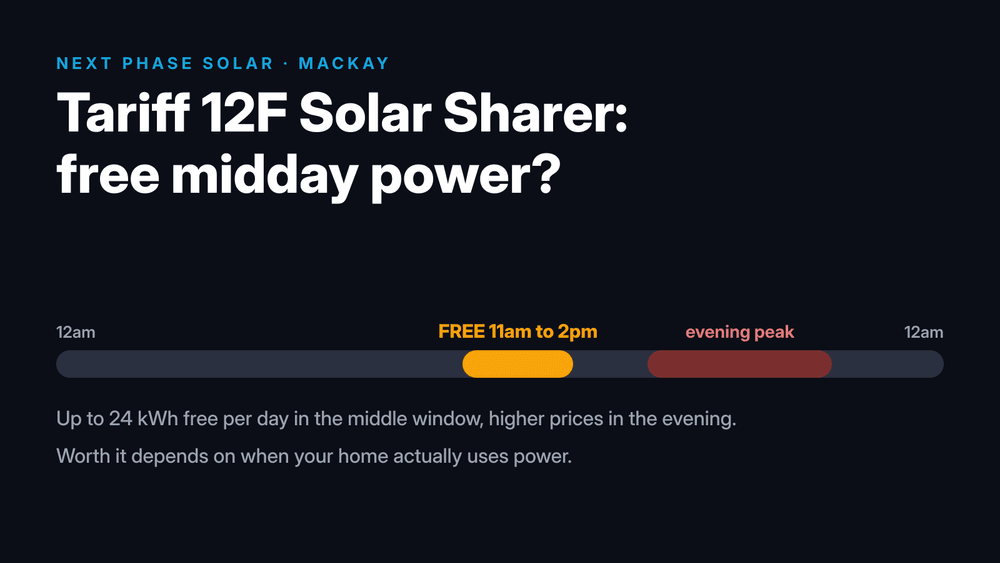
The honest answer: Ergon tariff 12F gives you three free hours of power a day, from 11am to 2pm, up to 24 kWh. That sounds great, and for some homes it is. But the daily supply charge is higher than the popular 12E tariff, so 12F only really wins if you can shift a decent chunk of usage into that free window. The clearest way to do that is a battery. If you have solar and no battery, 12E often still beats it.
The short version
12F rewards one thing: moving load into 11am to 2pm. Charge a battery, run the pool pump, heat the hot water, cool the house, charge the car. Do enough of that and the free window more than covers the higher daily charge. Do very little of it and you quietly pay more all year, plus a one off fee to switch. It is a good tariff, but it is not a free lunch for everyone.
What tariff 12F actually is
12F, the “Solar Sharer” offer, is available to Ergon residential customers with a smart meter, whether you have solar or not. The headline feature is a free usage period between 11am and 2pm, up to 24 kWh per day. Anything over 24 kWh in that window, plus usage from 2pm to 4pm, is charged at the day rate. Everything else is peak (4pm to 9pm) or night.
Here is how it compares to 12E, using current Ergon retail rates including GST:
| Charge | 12E (current) | 12F (Solar Sharer) |
|---|---|---|
| Daily supply | $1.5673 | $1.77853 |
| Free 11am to 2pm (up to 24 kWh) | not available | $0.00 |
| Day / off peak | $0.07004 | $0.08101 |
| Peak (4pm to 9pm) | $0.47206 | $0.48902 |
| Night | $0.25593 | $0.26412 |
Notice that every rate on 12F is a little higher than 12E, and the daily supply charge is a lot higher. The free window is the only thing pulling in your favour.
Who 12F is genuinely good for
- Homes with a battery, or getting one. You charge the battery for free between 11am and 2pm, then run the house off it through the 48 cent peak. This is where the real money is.
- High daytime users with no solar. If you are home during the day and can push cooling, laundry, pool and hot water into 11am to 2pm, the free 24 kWh can outweigh the higher supply charge.
- EV owners who can plug in during that window, especially on weekends.
Who should probably stay on 12E
- Solar homes without a battery. At midday you are already making your own power, so a free grid window does not help you much, and you are now paying a higher daily charge for nothing.
- Anyone on the old 44 cent feed in tariff who exports a lot. Changing tariffs can affect your arrangement, so confirm this with Ergon before you switch.
- Low daytime users. If the house is empty from 11am to 2pm and you cannot shift load there, the free window is wasted.
The catch nobody mentions: the daily supply charge
The daily supply charge jumps from about $1.57 on 12E to about $1.78 on 12F. That is roughly 21 cents a day, or about $77 a year, that you pay before you use a single kilowatt. Your free window has to claw back that $77 before you are even, and then more to actually come out ahead. That is exactly why 12F is fantastic with a battery and poor without one.
The one off switch fee
Moving to 12F is not just a phone call. You need a licensed electrician to do the metering work, and Ergon charges a one off fee of $208.71 including GST for a standard residential property, added to your bill. Factor that into your first year maths.
How to actually make 12F pay: a battery
A battery turns 12F from “maybe” into “yes”. You force charge it from the grid for free between 11am and 2pm, up to 24 kWh, then run your home off that stored power through the expensive 4pm to 9pm peak. Even on a rainy day you still get a full battery for free, which is the part solar alone cannot promise.
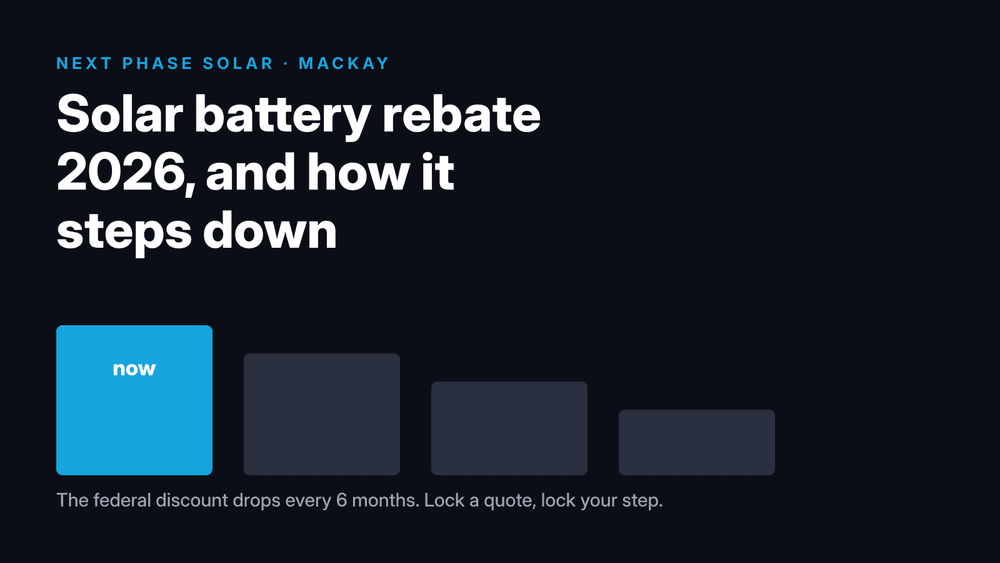
And the timing is good. The federal Cheaper Home Batteries rebate is live right now and takes roughly $2,800 off a 10 kWh battery and around $3,800 off a 13.5 kWh Tesla Powerwall 3 in Mackay, applied straight off the price. It steps down every six months, so it is at its highest today. Pair that rebate with 12F and the free window and the numbers start to look very different. See our solar battery rebate guide and our page on home batteries for the detail.
Frequently asked questions
Is 12F worth it if I have solar but no battery?
Usually not. At midday your panels already cover your usage, so the free grid window adds little, and you are stuck paying the higher daily supply charge. Most solar only homes are better off on 12E unless they use a lot of grid power during the day.
Does 12F change my solar feed in tariff?
Your feed in depends on your plan, and moving tariffs can affect it, especially if you are on the premium 44 cent rate. Confirm your feed in with Ergon before you switch, because for high exporters that can outweigh the free window.
How much is the free power actually worth?
Up to 24 kWh a day at zero cents. It is worth the most when that power would otherwise have cost you the peak rate, which is what happens when you use it to charge a battery. If those kWh would only have been cheap day usage anyway, the benefit is much smaller.
What does it cost to switch to 12F?
A one off Ergon fee of $208.71 including GST, plus the licensed electrical work to set up the metering. There are no lock in contracts or exit fees on the tariff itself.
Should I get a battery just to use 12F?
A battery makes 12F genuinely worthwhile, and with the current rebate the payback is stronger than it has been. But it should stack up on your own usage, not on hype. Send us your last 12 months of usage and we will run the numbers honestly, including whether 12F even suits you.
The honest bottom line
12F is a real opportunity, but only if you can move load into that 11am to 2pm window, and a battery is the cleanest way to do it. If you cannot, the higher supply charge quietly costs you. Before you pay the $208 to switch, it is worth knowing your own numbers. Send us your usage data and we will tell you straight whether 12F, a battery, or staying on 12E makes you the most money. Get a free assessment.
Sources
- Ergon Energy residential tariffs, current rates and metering charges, ergon.com.au
- Queensland Competition Authority, regulated retail electricity prices for regional Queensland: qca.org.au
Last reviewed July 2026. Tariff rates and fees change; confirm the current tariff card with Ergon before you switch.