The honest answer for 2026: the solar battery rebate in Queensland is the federal Cheaper Home Batteries Program. There is no separate Queensland state battery rebate any more. In Mackay it is worth roughly $280 per usable kWh from 1 May 2026, which is about $2,800 off a 10 kWh battery, taken straight off the price at the point of sale. It also steps down every six months, so the rebate is at its highest now and shrinks from here.
The short version
One rebate applies in Queensland: the federal scheme. It discounts a home battery based on its usable capacity, it is applied upfront by your installer, and you never lodge paperwork yourself. In Mackay a 10 kWh battery gets roughly $2,800 off and a 13.5 kWh Tesla Powerwall 3 gets roughly $3,800 off. The exact figure moves with the market price of certificates and with your battery size.
Is there a Queensland state battery rebate in 2026?
No. The old Queensland Battery Booster grant closed, and in 2026 Queensland homeowners rely on the federal program. So if you see an ad promising a “QLD battery rebate” on top of the federal one, treat it carefully. What you actually get is the single federal discount, which is generous on its own.
How much the federal rebate is worth in Queensland
The rebate is paid through Small-scale Technology Certificates tied to your battery’s usable kWh. Because certificate value depends on your STC zone, the per kWh figure is slightly higher in the tropics than the national average.
| STC zone | Where | Rough value per usable kWh (from 1 May 2026) |
|---|---|---|
| Zone 1 | Far North Queensland | around $330 |
| Zone 2 | Mackay, the Whitsundays, Brisbane, coastal QLD | around $280 |
| National average | All of Australia | around $252 |
In real money for a Mackay home (Zone 2):
| Battery size | Rough rebate in Mackay |
|---|---|
| 10 kWh | around $2,800 |
| 13.5 kWh (Powerwall 3) | around $3,800 |
| 20 kWh | around $4,900 |
These are indicative. The certificate price floats, so your installer confirms the exact discount on the quote.
The tier cap, so bigger is not always better
From 1 May 2026 the rebate tapers by capacity. You get the full rate on the first 14 kWh of usable storage, 60 percent on the portion from 14 to 28 kWh, 15 percent from 28 to 50 kWh, and nothing above 50 kWh. For most homes a 10 to 14 kWh battery sits in the full-rate band, which is also the size that actually matches a typical evening load. Going much bigger buys you a smaller rebate per kWh and a longer payback.
It steps down every six months
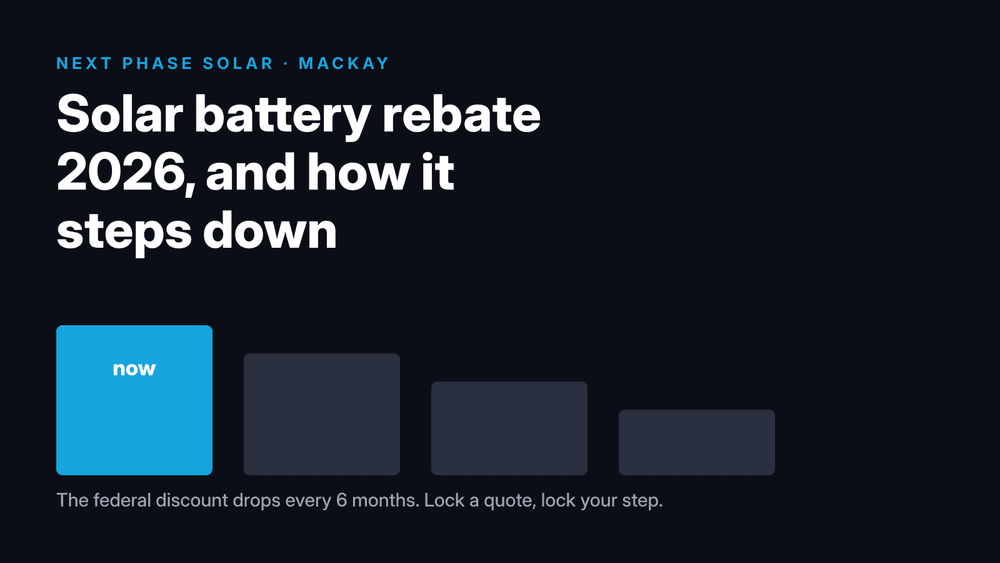
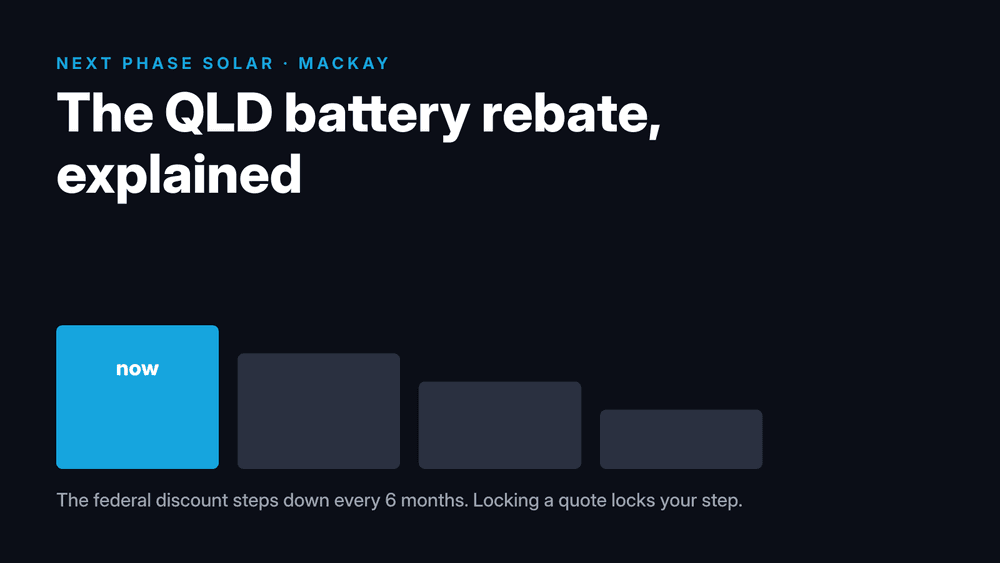
The federal rate is not fixed. It drops on a schedule every six months through to the scheme’s end in 2030. The Mackay Zone 2 value was higher before 1 May 2026 and is lower in each later period. The hardware is not getting cheaper fast enough to make up for a shrinking rebate, so the cheapest time to install is early in a rebate period rather than waiting.
What you need to qualify
- The battery must be paired with solar, either solar you already have or a new system installed at the same time. A battery on its own does not qualify.
- It is claimed once per property.
- The battery and installer must meet the program rules, including using an approved battery model and an accredited installer who signs off the job.
We handle the eligibility check and the certificate paperwork as part of the install, so the discount simply appears on your quote.
What about the solar panel rebate?
Separate to the battery scheme, rooftop solar panels still attract the federal STC discount, which knocks several thousand dollars off a typical system and also steps down over time. If you are adding panels and a battery together, both discounts apply. For what panels themselves cost after that discount, see our guide on how much solar panels cost.
Frequently asked questions
Is there a Queensland state solar battery rebate in 2026?
No. The Queensland Battery Booster grant has closed. In 2026 Queensland homeowners use the federal Cheaper Home Batteries Program, which is applied as an upfront discount by your installer.
How much is the battery rebate worth in Mackay?
Roughly $280 per usable kWh from 1 May 2026, because Mackay sits in STC Zone 2. That is about $2,800 off a 10 kWh battery and about $3,800 off a 13.5 kWh Powerwall 3. The exact figure depends on the certificate market price on the day.
Do I have to claim the rebate myself?
No. It is claimed at the point of sale. Your accredited installer assigns the certificates and the discount comes straight off your invoice, so there is no rebate form for you to lodge.
Can I get the battery rebate without solar panels?
No. The battery has to be paired with a solar system, existing or new. A standalone battery is not eligible.
Should I wait for the rebate to get bigger?
It will not get bigger. The federal rate steps down every six months until 2030, so waiting means a smaller discount, not a larger one.
Sources
- Cheaper Home Batteries Program, DCCEEW
- Rebate values, STC zones and the 1 May 2026 changes, Solar Choice
- Federal battery rebate explainer, SolarQuotes
What to do next
If you want to know whether a battery stacks up for your home before you look at the rebate, start with our honest cost-benefit guide, Are home batteries worth it in Mackay in 2026?, and our Tesla Powerwall vs Sungrow vs BYD comparison.
Next Phase Solar designs and installs battery systems across Mackay and the region, sized against your real Ergon bills, with the federal rebate applied upfront and the job signed off by a Queensland licensed electrician. See the home battery service for what is included.
Get a battery quote with the rebate already applied at /quote
Last reviewed June 2026.