The short answer: size your solar system from your actual daily power usage, not your roof size or a brochure default. A rough rule is your average daily usage in kWh, multiplied by 1.2 for losses, divided by your local peak sun hours. For most Australian homes that lands between 6.6 kW and 13 kW. Size the battery to your evening and overnight load, not to your solar output.
How to size the solar system
Pull your daily usage off your power bill in kWh, then:
Daily usage (kWh) times 1.2 divided by peak sun hours equals the system size in kW.
A home using 30 kWh a day with 5 peak sun hours needs around 7.2 kW. The average Australian home uses about 16 kWh a day, though all-electric homes with air-con, electric hot water and a pool can run 30 kWh or more.
Common sizes in 2026:
- 6.6 kW: the long-standing sweet spot for price per kW. Around 15 panels with a 5 kW inverter. Covers a typical home through the sunny middle of the day.
- 10 kW: generates about 40 kWh a day on average. Suits homes using 20 to 30 kWh a day.
- 13 kW: enough to run a fully electrified home.
The current advice across the industry is simple: fit as many panels as your roof and budget allow. Feed-in tariffs have fallen to a few cents, so the value is in using your own power, not selling it. A bigger array also leaves room for a battery, an electric car and electric hot water later, and the extra panels cost little once the crew is already on the roof.
Why hot, air-conditioned homes need more
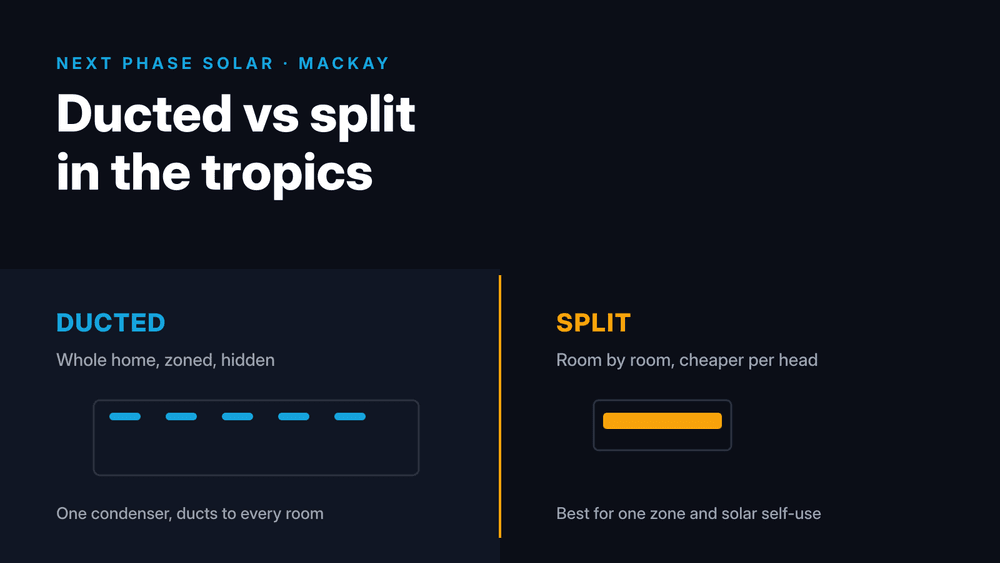
Air-conditioning is a heavy load. A split system draws roughly 0.6 to 2.5 kW, and ducted air-con can use 3 to 5 kWh for every hour it runs. In tropical North Queensland, where cooling runs for much of the year, annual power use is far higher than in a temperate southern city, so the system needs to be bigger to match.
The upside is that the sun is strong here, so each panel produces more. The catch is that the load is also much larger, which is why a Mackay or Whitsundays family home often needs 8 to 13 kW rather than the 6.6 kW that suits Brisbane.
A practical note for the tropics: lithium iron phosphate batteries handle 40 degree heat better, and any battery should sit in a shaded, well-ventilated spot. Heat shortens battery life.
How to size the battery
Size the battery to the load you need to cover after the sun goes down, not to your solar output or your total daily use. About 70 percent of a typical home’s usage happens in the evening and overnight.
A good rule of thumb is at least 25 percent of your daily usage plus a 2 kWh buffer. A home using 16 kWh a day uses roughly 11 kWh overnight, so a 13 to 14 kWh battery covers it with headroom. Most homes land in the 10 to 13.5 kWh range. Add an electric car or electric hot water and you move toward 13 to 15 kWh or more.
Always size on usable capacity, not the nameplate number. A lithium iron phosphate battery gives roughly 90 to 95 percent of its rated capacity, and if you reserve part of it for blackout backup, your day-to-day usable figure drops further.
Bigger is not better. A battery costs roughly $800 to $1,000 per kWh before the rebate, so every kWh you never use is dead money. An oversized battery sits half empty because there is not enough surplus solar to fill it or enough evening load to drain it.
The two rules that catch people out
- The 133 percent rule. You can install up to 33 percent more panel capacity than your inverter rating and still claim the solar rebate. A 5 kW inverter pairs with up to about 6.6 kW of panels. Going over, even slightly, can void the rebate. Systems with a battery can usually exceed this.
- The 5 kW export cap. Most single-phase homes can only export 5 kW to the grid without special approval. This does not stop you installing a bigger system. With an export-limiting inverter you can run a large array for self-consumption and simply cap what flows to the grid. Three-phase homes get more headroom.
Frequently asked questions
What size solar system do I need for my home?
Take your average daily usage in kWh, multiply by 1.2, and divide by your local peak sun hours. Most Australian homes land between 6.6 kW and 13 kW. Use 12 months of real usage rather than an average.
What size battery do I need?
Size it to your evening and overnight load, roughly 25 percent of daily usage plus a 2 kWh buffer. Most homes suit 10 to 13.5 kWh of usable capacity. Add an electric car or electric hot water and go larger.
Why do tropical homes need bigger solar systems?
Air-conditioning runs for much of the year in North Queensland, so annual power use is high. A family home here often needs 8 to 13 kW versus the 6.6 kW that suits a cooler southern city.
Can I install more panels than my inverter is rated for?
Yes, up to 33 percent more under the 133 percent rule, and still claim the rebate. A 5 kW inverter pairs with up to about 6.6 kW of panels.
Sources
- Sizing a system and battery, SolarQuotes
- Inverter sizing and the 133 percent rule, SolarQuotes
- Size your solar system, energy.gov.au
What to do next
The right size depends on your actual bills, your roof and your routine, which is why we look at 12 months of usage before we quote rather than reaching for a default. For the cost side, see our solar battery price guide for 2026, and for the storage side our home batteries page. If you only want the panel count, see how many solar panels you need.
Get a system sized to your home at /quote
Last reviewed June 2026.